
Best Board Games for Couples | How to Choose for a Date Night at Home
Best Board Games for Couples | How to Choose for a Date Night at Home
Can you play two quick rounds of a 15-minute game on a rainy evening and call it a great night? Can you spend a relaxed hour on a longer game on the weekend and feel like you genuinely played together? Choosing the right board game for a date night at home comes down to reading the mood — get that right, and you're unlikely to go wrong. The simplest shortcut is to start with 2-player dedicated games in the 10–30 minute range.
Can you play two quick rounds of a 15-minute game on a rainy evening and call it a great night? Can you spend a relaxed hour on a longer game on the weekend and feel like you genuinely played together? Choosing the right board game for a date night at home comes down to reading the mood — get that right, and you're unlikely to go wrong. The simplest shortcut is to start with 2-player dedicated games in the 10–30 minute range. Decide upfront whether you want a competitive back-and-forth or a cooperative, low-pressure experience, then pick tonight's game and a backup candidate — that way you'll land on a winner without stress. This article organizes the classics — Patchwork, Codenames: Duet, 7 Wonders Duel, Targi, and more — by play time and compatibility, using three criteria as the backbone. By the end, you should have a clear sense of your first pick and a few to try next.
3 Criteria for Choosing a Board Game for a Couple's Date Night
The criteria are actually straightforward: is it designed for 2 players, does it play in 10–30 minutes, and does it fit the mood you're both in right now? Nail those three, and you sidestep the most common traps — "that was heavier than expected," "the rules alone wore me out," or "only one of us ended up taking it seriously."
Date nights at home are an experience that includes everything around the game, not just the game itself. Opening the box, explaining the rules, playing one or two rounds, grabbing drinks, tidying up. The titles that make that whole sequence feel natural are the ones that stick in your memory. From personal experience, if you're starting around 9 pm on a weeknight, a game in the 10-minute range that you can play twice — rules explanation and cleanup included, all wrapped up in about 30 minutes — tends to be just right.
Quick Glossary: Cooperative, Competitive, Social Deduction, Bluffing, Worker Placement
Here are a few terms that come up often, unpacked through the lens of a date night. Understanding what these actually mean makes it easier to ask, "which of these sounds like us?"
Cooperative games put both players on the same team, working toward a shared goal. When you fail, it's "we didn't get there together" rather than "I lost to you," which keeps the atmosphere relaxed. Codenames: Duet is a great example — the way someone gives clues reveals how their mind connects words, turning the communication itself into the game.
Competitive games are about reading each other's decisions and enjoying the back-and-forth. In a 2-player setting this sharpens considerably. Patchwork packs that tension right in: "Do I take this tile now, or keep it away from them?" Suits couples who enjoy a healthy contest.
Social/party games lean on word association and the comedy of mismatched thinking. Many overlap with cooperative designs, but the real delight is that "oh, that's how you read it?" moment. Conversation rarely dries up, so they work well as a kind of background activity for quieter evenings.
Bluffing means hiding intent and trying to read — or mislead — your opponent. Geister is the classic example: pieces have hidden identities and every move is a gambit. Done well, it becomes a psychological thriller you won't forget. That said, not everyone enjoys being deceived as entertainment.
Worker Placement means claiming spaces with your tokens to take actions. The appeal is the puzzle of sequencing and area control, but it demands enough focus that idle chat becomes harder. Targi is the go-to 2-player example in this space — save it for a weekend when you want to dig in.
Think of these labels less as strict categories and more as a map for asking "what kind of conversation will this game spark?" Cooperative for a harmonious evening, competitive for the thrill of going head-to-head, social for easy conversation that doesn't need managing. For couples, that read matters just as much as knowing the titles themselves.
Why 2-Player Dedicated Games Deserve Priority
The first criterion: if you're playing as a pair, look at 2-player dedicated games first. This isn't a matter of taste — it's about design intent. Dedicated 2-player titles are built from the ground up for a 1-on-1 face-off: action density, information visibility, the weight of interference, pacing to a conclusion — all calibrated for two. That means less waiting, and every move your opponent makes immediately means something.
The difference is noticeable once you've played both. 7 Wonders Duel and Splendor Duel are both designed exclusively for two, and that "build your path while watching theirs" feeling is baked in from turn one. There's almost no time where you're just watching the board — the pace is quick enough that conversation and eye contact naturally stay on the game. It's no accident that rankings like Boardgamegeek's 2-player charts are dominated by dedicated 2-player titles.
Multi-player games that "work with two" are mechanically valid but can feel like you're missing something. A game built around 3–4-player negotiation and shifting alliances often loses its main draw when you cut it to two — it becomes "fine, but this could be any game." Catan is the textbook example: it's designed for 3–4 players, and while 2-player rules exist, the heart of the game — trading, board fluidity, table dynamics — lives in the larger player count.
That said, there are exceptions. Azul is a 2–4 player game that actually sharpens in 2-player mode — the reads get crisper and strategy comes into clearer relief. Being a multi-player game doesn't automatically make it a miss. The real question is whether the 2-player experience feels complete or hollowed out. Still, when it comes to avoiding a bad first impression, leading with dedicated 2-player titles is the safer bet.
One more thing worth noting: 2-player games are also easier to teach (Rules explanation). When explaining a multi-player game, you often have to navigate "this rule only applies with 3 or more" and "for 2 players, change this step" — branches that add up. On a date night, the longer the explanation, the more the energy before playing deflates. A light game with a 5-minute setup is a meaningful advantage here too.
/og_default_image.png)
友人・カップル・夫婦など2人で遊ぶ!おすすめボードゲーム 人気ランキング トップ50
ボドゲーマ会員が「お気に入り」にしている、2人用のおすすめボードゲーム(アナログゲーム)のトップ50ランキングです。
bodoge.hoobby.netWhy Starting in the 10–30 Minute Range Works
The second criterion: start with games that play in 10–30 minutes. Short games clear the bar of "we can start right now," which matters especially on weeknights.
The biggest advantage of short games is that you don't have to form a verdict in one sitting. Round one is for learning the rules; round two is where it clicks. That arc helps even total newcomers avoid the "we finished before we understood it" feeling. Quarto runs about 10–15 minutes, Geister 10–20, and Patchwork around 15–30. Short enough that "one more?" comes out naturally, and a loss doesn't linger.
In two hours after dinner, Patchwork can realistically get 3–6 plays. Play that many rounds and you start seeing the texture of decisions that aren't visible in a single game — and conversation shifts from "I won, you lost" toward "that shape I picked in round two, that was interesting." Short games build experience faster than long ones.
💡 Tip
On a weeknight, two rounds of a 15-minute game tends to be the sweet spot. Everything from explanation to cleanup fits in about 30 minutes — perfect for "I'm tired but I still want some time together."
The third criterion — choosing by relationship dynamic — connects directly to this sense of time. Cooperative for a harmonious night: Codenames: Duet. Back-and-forth tension: Geister or Lost Cities. Wanting to think a bit harder on the weekend: 7 Wonders Duel or Splendor Duel. For a real commitment: Targi at around 60 minutes. The spectrum from short to long is wide, but for couples, starting at the lighter end and working up is the approach least likely to misfire.
Starting with short games also reveals what "the right weight" feels like for the two of you. Do you want more thinking, more laughing, more cooperating? Once you have that read, stepping up to a 60-minute game feels like gaining something rather than being burdened by it. That's a lesson in board game selection generally — but it's equally a lesson in keeping date-night energy intact.
クリエイターが選ぶ!2人で遊べるボードゲーム15選を紹介 | 京大ボドゲ製作所 | Kyobo
パートナーや友人とじっくり2人で楽しめるボードゲームは、大人数とはまた違った魅力がありますよね。 この記事では、 2人で遊べるボードゲームをじャンル別に厳選してご紹介します !ルールが簡単な初心者向けから本格的な玄人向けまで、さまざまなゲー
kyodai-boardgame.comWhere to Start: 5 Essential Games for Beginner Couples
These five were chosen because they share a specific quality: quick to explain, smooth for two players to finish, and likely to leave you wanting another round. Some lean competitive, some cooperative, but all of them work as a first game. Light-to-medium 2-player titles in particular make it easy to see how much conversation you'll have and how intense the competition feels — useful for figuring out what suits you as a pair.
Patchwork — 2-player / ~15–30 min / The go-to first game for beginners. Approachable look, satisfying decisions | Mood: relaxed / sense of accomplishment
Patchwork is 2-player, ~15–30 minutes, ages 8+. The Japanese edition is distributed by Hobby Japan, where the listed price is ¥3,800 (~$25 USD) + tax. Mood-wise, it's perfect for a night when you want a little competition but not aggression — something cute, with a real sense of completing something.
The game has you picking fabric-shaped tiles and fitting them onto your personal board. The rules aren't complex, but the first stumble usually comes from realizing it's not just "take the shape you want" but "take the right shape while watching the time track and button income." If you chase aesthetics alone, your hand slows down. The game opens up the moment "I want that tile for myself" expands to include "I want to keep it away from them." The shift from fitting a pretty puzzle to playing a tactical tug-of-war is a drama even newcomers can feel.
The moments that spark reactions: when a piece slots in perfectly, and when you snag the exact piece your opponent was eyeing. The soft visual style belies how sharp the endgame gets. And at 15–30 minutes, two hours after dinner gives you 3–6 rounds — with the game proper feeling like it starts on round two, once the rules are in your body.
One heads-up: the charming look can set a misleadingly gentle expectation. This is a competitive game. You'll naturally start blocking your opponent's preferred tiles, and losing a close one stings a little. Better for a "let's have a friendly match" mood than a "let's solve this together" one.
Solid specs, just enough challenge to feel satisfying, and a reputation for being a safe first choice — it's no surprise Patchwork shows up first in nearly every "board games for beginner couples" roundup.
【ボードゲーム】初心者カップルにおすすめ!2人で楽しめるボードゲーム6選【ぬー】名古屋の謎解きカフェ&ボードゲームカフェ:なぞねこ
ボードゲームカフェに勤務する初心者が、実際に遊んで「楽しい!」と感じた2人で楽しめるボードゲームを5つ紹介しています!
nazoneko.jpCodenames: Duet — 2-player cooperative / 20–30 min / A word game that naturally generates conversation | Mood: harmonious / good talk
Codenames: Duet supports more than 2 players but shines brightest as a 2-player experience. Listed play time is around 15 minutes, ages 11+. Japanese edition distributed by Hobby Japan. The mood this suits is simple: evenings where conversation matters more than winning.
The game is built around giving a one-word clue that links multiple words on the grid. The rules aren't hard, but the first-session trap is going quiet because you're trying too hard to craft the perfect clue. Once you realize it's less "guess the right answer" and more "probe how your partner's mind works," everything loosens up. The gap between what you intended and what they understood becomes the fun.
The moment the game sparks: when your clue lands exactly right and your partner connects all the dots. That shared-wave feeling is something only cooperative games deliver. The flip side — a near-miss where your partner almost got it — tends to land as laughter rather than frustration. One mission finishes quickly, so the rhythm of "play, reflect briefly, go again" comes naturally.
Worth knowing: the experience depends heavily on associative compatibility rather than vocabulary size. If you both enjoy playing with language, this hits hard. If word-based thinking games aren't your thing, the energy might not ignite. Also, rushing to correct answers flattens the enjoyment — treat it as a different kind of game from competitive titles, and you'll be in the right headspace.
That natural "solving together" quality makes it a smart entry point for couples where head-to-head competition tends to create tension. It reliably shows up in curated 2-player roundups for exactly that reason.
ボドゲ夫婦が選ぶ!2人用ボードゲームのおすすめTOP33 | ぼくボド
カップルや夫婦におすすめの2人用ボードゲームランキング。ボードゲームレビューを400記事以上書いた僕と妻で選んで点数をつけてランキングにしています。
boku-boardgame.netGeister — 2-player / 10–20 min / Bluffing and mind-reading in quick back-to-back rounds | Mood: tactical / psychological
Geister is 2-player, 10–20 minutes. Age range varies by source, but it's described across the board as accessible from a young age — a genuine classic. A reference price of ¥2,800 (~$19 USD) appears in listings. Mood-wise: light on surface, heavy on psychology underneath.
The rules are surprisingly simple. Line up ghost pieces with hidden identities and move them. Capture your opponent's "good ghosts," or get your own "good ghosts" off the board, and you win. The first session trap: to disguise which pieces are key, you need to move suspicious pieces deliberately. This isn't chess — "looking like the wrong move" has real value. Once that clicks, the game transforms.
The moments that spark reactions: successfully steering your opponent into capturing a red ghost, or watching a piece that looked like bait quietly slip off the board. At 10–20 minutes per game, a misread doesn't drag — "I fell for it last round, I'll read it this time" is all the motivation you need to play again. Short games, dense stories.
One honest note: the game's entire appeal is built on deception. If reading faces and moves is something you both enjoy, this is deeply satisfying. If bluffing as a concept doesn't appeal, the game will read differently. Conversation tends toward charged silences of the "oh, that move" variety rather than constant chatter.
The reason win and loss both feel fair and speakable makes it an excellent entry point for short competitive play. A classic that hasn't aged.
Quarto — 2-player / ~10–15 min / Minimal rules, striking to look at | Mood: quick game / visual appeal
Quarto is 2-player, ~10–15 minutes, ages 6–8+ depending on the source — either way, squarely on the accessible side. Retail price is approximately ¥3,740 (~$25 USD) including tax. The wooden pieces photograph beautifully, and the moment you set up the board it looks like a design object — low barrier from the moment the box opens.
What makes Quarto distinctive is that you don't choose which piece to place — you place the piece your opponent hands you. The reverse is also true: you choose what to hand them. That single sentence covers most of the rules. The first-session confusion is usually exactly this "passing" mechanic. It looks like Connect Four, but the moment you understand it as "what do I give my opponent to trap them?", the whole board deepens by a level.
The sparks: when an innocuous pass from your opponent turns out to complete your winning line, or the inverse — "I can't give them any piece without it being dangerous." Visually quiet, but winning conditions can materialize in just a few moves, so the density is real despite the short runtime. Two rounds in 30 minutes, four in an hour — easy to slip into a "just one more" rhythm.
Worth noting: short rules don't mean equal footing. Spatial reasoning gaps show up here. Spotting shared attributes across color, height, hollow/solid, and shape takes practice — early misses are common. The saving grace is that one round is short enough that the sting doesn't accumulate.
Great looks, compact rules, clean endings — this is a strong "let's try one" game to keep on the table.
Jaipur — 2-player / 30 min / Fast turns that make "one more?" easy to say | Mood: tempo / collection
Jaipur is 2-player, ~30 minutes, ages 12+. Japanese edition from Hobby Japan. The theme — buying and selling goods in a market — pairs well with the snappy card game rhythm, and the 2-player design means the tactical edge is always right there.
The first-session challenge is finding the balance between "collect more" and "sell now." The rules themselves are clean, but getting a feel for when the market timing is right takes a round or two. Once that lands, it stops being hand management and becomes a race to lock in value before your opponent does — and it suddenly gets interesting.
The sparks: when your collected goods sell at a premium, and when you tap into a color your opponent was clearly stockpiling, throwing off their flow. Turns process quickly and next moves are readable, making this one of the faster-feeling entries in the 30-minute tier. "I want to replay that opening" comes naturally, and back-to-back games work well.
Worth noting: despite the friendly trading theme, this is a competitive game about watching how your opponent picks up and sells. Turns flow lightly, but you can't win by collecting blindly — the reads are there. Less "chatting while playing" and more "focused sparring with banter in between."
A well-balanced 30-minute slot that works nicely as the next step from Patchwork for couples who want to move slightly more into card game territory.
Patchwork's appeal is the coexistence of its soft visual style and exactly the right amount of decision-making when you're actually playing. "Fit tiles to make your fabric board" is a premise that creates a mental image instantly — easy to hand to a partner who's new to board games. Then you start playing and realize shape, time, and income all interact, leaving a small story in every round. It doesn't bottom out at "cute" — each game reveals new lines. That's why it earns the "first game" label.
Codenames: Duet is the cooperative standard for when you want to play in the same direction. Give a clue, receive it, laugh at the gap. That cycle happens naturally, and it makes conversation flow through the game rather than around it. Wins and losses both get remembered as "how did we think?" rather than scorelines — a cooperative game that works well even on quiet evenings.
Geister is a classic where the psychological outline is sharp despite the short runtime. Hidden-identity pieces moving across a small board raise "is that the real target, or a decoy?" from the first turn. Simple rules, but every move carries weight — if you enjoy that kind of tension, this is an easy recommendation for couples who like a genuine contest.
Quarto leaves you with the impression of beautiful wooden pieces and rules you can explain in a minute. It looks like Connect Four until you learn the twist — your opponent picks what you place. Deep reads in a game you understand within minutes. Good-looking, fast to set up, quick to play. Clean fit for date nights.
Jaipur brings approachable theme and the snappy pace of a 2-player dedicated game together well. Collecting and selling is intuitive, easy for card-game newcomers to follow — and the reads against your opponent are genuinely there. 30 minutes with real satisfaction and a "go again?" that doesn't feel heavy. A well-positioned choice for couples who want light competitive fun.
悪いな、このゲームは2人用なんだ『パッチワーク』 | ホビージャパンゲームブログ
hobbyjapan.co.jpGames Under 30 Minutes and Games to Sink Into on the Weekend
Short (10–30 min): Quarto / Geister / Patchwork / Lost Cities
If you're choosing by time, weeknight evenings live here. The rule of thumb for "easy, casual play" is 10–30 minutes — and when you look at the full spectrum of 2-player board games (which runs from about 15 minutes to over 2 hours), the message is clear: what you should play depends on how much space you have tonight.
Why Short Games Work
The real strength of short games is that one round is a unit, but two rounds is the real session. A 20-minute game played once can end right as you're getting a feel for it. Play it twice and the mistake from round one becomes the experiment for round two. Learning converts to rematch immediately — short games create momentum in a way longer ones don't. After dinner, slumped on the couch, "same game again?" is easy to say. That's a meaningful quality.
Quarto at 10–15 minutes is the purest example. Explanation is minimal, but the "opponent hands you your piece" twist means rounds one and two look completely different. A loss doesn't weigh you down — "I missed that, let me try again" is right there.
Replayability in Short Sessions (Quarto as the example)
At 10–15 minutes, Quarto makes each rematch feel like new territory. The rules land in minutes, but the "passing" dynamic means you're reading the game differently each time. A loss becomes forward-looking rather than frustrating.
Patchwork at ~15–30 minutes brings what we mentioned earlier — soft look, real strategic weight. It's strong on weeknights because one game is satisfying on its own, but two hours gives you 3–6 rounds. Play enough and you start seeing your personal patterns: opening choices, pacing, where you tend to lose time. "Last round I went for shapes — this time I'll prioritize button income" is the kind of micro-strategy that becomes the conversation.
Lost Cities at ~30 minutes sits toward the thoughtful end of the short tier. It looks like just laying numbers in sequence, but every turn is a question of "do I commit now or hold longer?" — tension that doesn't require heavy thinking to feel real. If Quarto and Geister are reactive, Lost Cities is a 30-minute slow burn.
What these four share: lightweight rules, and wins and losses that both generate conversation. Short games aren't about shallow strategy — they're about how much emotion moves in a small window. Strong on weeknights because they deliver real satisfaction in a compact form.
Medium (30–60 min): 7 Wonders Duel (2-player / 30 min / ages 10+) / Splendor Duel (2-player / 30 min / ages 10+) / Azul
Stepping into 30–60 minutes changes the texture. Where short games give you "that move made me laugh" and "rematch right now," medium games bring planning, having your plan disrupted, and the pleasure of rebuilding it. Possible on weeknights, but the feeling shifts from "quick one" toward "this is the game we're playing tonight."
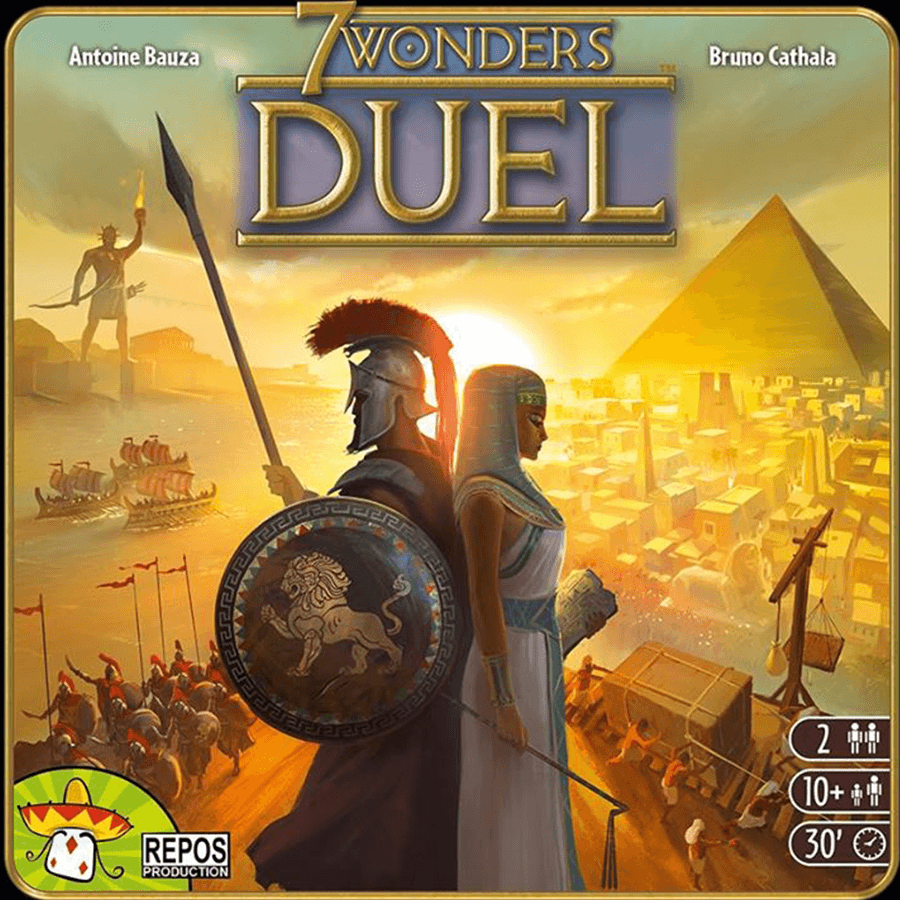
7 Wonders Duel — 2-player, ~30 minutes, ages 10+. Even at 30 minutes, growing a civilization means every card pick accumulates. Taking a card changes your opponent's options, so just building your own tableau isn't enough. The reads are a layer deeper than short games, and "how does this move play out three turns from now?" becomes a real question.
Splendor Duel — also 2-player, ~30 minutes, ages 10+. Same duration, different feel. Here the pleasure is the rhythm of resource collection and the surge when your engine gets going. The Japanese edition's list price is ¥3,960 (~$26 USD). The game rewards accumulation — small early gains chain into big mid-game plays — and "is this the setup phase or the closing move?" is the central judgment. Stronger sense of "I built something" than the short-game tier.
Azul — 2–4 players, 30–45 minutes, ages 8+. Beautiful tiles, sharper play than it looks in 2-player. Collecting the colors you want is satisfying, but reading what to deny your opponent, and which row to take first, is where the game gets serious. Less "conversation flows naturally" and more "both of us staring at the board." A different kind of satisfaction from lively short games — this one asks you to actually sit down and play.
The key distinction: short and medium aren't about quality, they're about what kind of satisfaction they deliver. Quarto, Geister, Patchwork — low barrier to the second round, and that's where the fun peaks. 7 Wonders Duel, Splendor Duel, Azul — each game builds to a point where you finish and feel "we actually played tonight."
ℹ️ Note
On weeknights, two rounds of a 10–30 minute game tends to satisfy. On weekends, one 30–45 minute game played well tends to hold up. Short games reward "learn and immediately rematch"; medium games leave a stronger sense of "we finished something."
Longer (~60 min): Targi
For a weekend session where you want to really dig in, Targi is the answer. 2-player, ~60 minutes, ages 13+. A fundamentally different weight from 30-minute games. Where short games are an exchange of "what do I do right now," Targi is "what board position am I building toward several moves from now?"
The game's character is that your strategy accumulates slowly across the session. Reading the outer ring, deciding where to place, what to secure — those choices compound and start mattering in the midgame. The tension is real, but it resolves through structural advantage rather than one decisive strike. When it ends, there's a distinct sense of "that session had an arc."
On a weeknight, Targi takes over the evening. That's not a criticism — on a weekend afternoon or evening, that weight is exactly right. 60-minute games are better played as a single satisfying event than in rotation, and Targi is the clearest example. The payoff is the feeling of having played one complete thing, not the quick-reload pleasure of short games.
A retail price of ¥2,930 (~$19 USD) appears in Yodobashi listings. Given the depth, the entry point is reasonable — this is an easy game to hold up as the anchor of a weekend 2-player library.
One useful reference point for time-based selection: 7 Wonders Duel at 30 minutes / ages 10+, Targi at 60 minutes / ages 13+. Both are 2-player dedicated, but the first is a weeknight candidate, the second is a weekend commitment. The age difference isn't a simple difficulty scale, but it does convey the difference in mental preparation. Duel — tight pacing, crossing win conditions. Targi — placement and accumulation, appreciated slowly. A 30-minute read and a 60-minute read leave different lengths of memory.
Azul occupies an interesting middle ground: not a 2-player dedicated game, but it plays dense at two. The 30–45 minute length fits weeknights, but the feel is quieter and sharper than short-game energy. Age 8+ suggests accessibility, but at the table, reading your opponent's preferred rows and colors takes time. Light rules producing medium-game focus — it bridges the time tiers.
7 Wonders Duel is a game that packs expanding tactical tension cleanly into 30 minutes. Every card shapes your civilization and changes your opponent's path — so each move is a dialogue. The lightness of a short game is still there, but you finish with the sense of having actually played a strategy game. The "densest 30 minutes" to end a weeknight on.
Splendor Duel makes the process of building momentum feel good — small early acquisitions chain into bigger mid-game plays, giving 30 minutes a real sense of construction. The competition for resources is real, but the board stays readable and nothing feels oppressively heavy. A natural next step when you want to move from short games to deeper tactical play.
Azul pairs striking visuals with sharp 2-player reads. Collecting tiles is intuitive, but at the table "what to take" matters as much as "what to leave." Moments where conversation stops and both of you are just studying the board. If you can enjoy that quiet together, this is a very satisfying medium-length game.
Targi deserves its place as the weekend dedicated-2-player game. Placement and resource management interlock, and early decisions pay off in the endgame, making the whole session one long strategic conversation. What you walk away with isn't just the result — it's the memory of how that particular game unfolded. The satisfying sense of completion is distinct from anything in the short-game tier.
Lost Cities carries a quiet intensity for a 30-minute card game. "I want to play that, but is it too soon?" — that question recurs every turn, and the tension never breaks. Short enough to play on a weeknight, adult enough in its reads to feel special. A good fit when you want stakes without drama.
世界の七不思議:デュエル / DUEL | ANALOG GAME INDEX
『世界の七不思議』に独立型二人用タイトルが登場!3つの時代を駆け抜けて文明を発展させよう!
hobbyjapan.gamesCooperative if You Want Harmony, Competitive if You Want Reads
What Cooperative Games Are Good For
At a recent session, a two-word clue completely changed the atmosphere at the table. Games like Codenames: Duet aren't about landing strong moves — they're about "how do I pass what I'm seeing to my partner." Associative gaps become conversation; when a clue lands, there's a small, shared moment of success. Win or lose, the result belongs to both of you — which makes it genuinely approachable for people who find competitive friction stressful.
Cooperative games particularly suit couples who want to enjoy the time spent consulting and moving forward together more than they want to test their skill against each other. Information sharing happens naturally. "I'll watch these candidates" / "then I'll work on eliminating the dangerous words" — roles emerge on their own. That kind of design hands you conversation starters without requiring effort. The table fills with words on its own.
Games that consistently generate conversation tend to share a few traits. One is association-based play — Codenames-style games are the archetype. Another is the shared puzzle format, where both players are looking at the same problem: "fill that section first?" / "that move might make the next step harder" — the back-and-forth comes naturally. A third is open information — when both players can see the whole board, neither one ends up silently deliberating alone. The reason cooperative games are called "easy to enjoy together" is that these structures are built in.
Quick play tempo is another strength. Codenames: Duet runs about 15 minutes, so an hour gives you several missions in sequence. Each one ends with "that clue worked" or "that connection was unexpected" — conversation naturally extends past the game itself. Major outlets tend to distinguish cooperative from competitive when recommending 2-player games precisely because the experiences feel that different.

2人で遊べるボードゲームおすすめ23選。協力系・対戦系に分けてご紹介
簡単なモノから高難易度のモノまで種類豊富なボードゲーム。なかでも2人で遊べるボードゲームは、誰か1人を誘えばすぐに楽しめる手軽さが魅力です。今回は、2人プレイにおすすめのボードゲームをピックアップ。協力系と対戦系に分けてご紹介します。
sakidori.coWhat Competitive Games Are Good For
That said, some of the most vivid 2-player moments live in competitive games. A single move doesn't just change the board — it changes your pulse. In a bluffing game like Geister, one small positional error becomes the whole story of that match. Is this piece the one they're trying to escape? Or the bait? The number of visible pieces is small, but what you're reading is your opponent's mind.
Competitive games suit couples who can enjoy low-stakes competition and find the act of reading each other genuinely interesting. The goal isn't to crush your partner — it's to be surprised by them. "You were thinking that?" / "That bluff was good" — relationships where you can appreciate the other person's thinking are where these games shine. The clear win-loss creates a story every single game. Dedicated 2-player titles dominate the list of classics partly because with no third party, that tension travels directly between two people.
There's still a graceful way into competitive play. Games least likely to cause friction are short and balanced between luck and strategy. A 10–30 minute game with a clean ending means a loss doesn't linger, and "let's go again" restores the temperature. If bluffing feels like too much too soon, starting with Patchwork or Lost Cities — where the edge comes from choices rather than direct attacks — softens the competitive edge. From there, the step to Geister or 7 Wonders Duel feels natural rather than jarring.
The appeal of competitive games isn't just winning. The time waiting for your opponent's turn becomes anticipation rather than waiting. What will they take? Where will they block? What do they let through? When your read is right, it's satisfying. When it's wrong, it becomes a story. In that sense, competitive games are especially strong for couples who can enjoy reads as another form of communication.
Building Up to Bluffing and Mind-Reading
Even if you're drawn to the idea of tactical reads, going straight into a full bluffing game can feel like pressure. The cleaner path is starting cooperative or social, then stepping into short competitive games. Getting a round or two of "we're consulting" and "I'm learning how they think" before competition means when you do go head-to-head, it feels like "reading someone I understand" rather than "going up against a stranger."
💡 Tip
When in doubt, game one as Codenames: Duet (cooperative), game two as Quarto or Geister (short competitive) is a reliable structure. Warm up the table before turning up the stakes — the tension of competition doesn't dominate from the start.
A useful progression:
- Open-information games that make consultation and prediction feel natural
When both players see the same board, explaining "why I made that move" is easy. Cooperative puzzles and word games build this foundation.
- 10–15 minute competitive games where losses don't accumulate
Quarto and Geister — quick enough that one bad move doesn't define the experience. Shorter games make individual mistakes easier to absorb and learn from.
- Medium-length games where reads compound over time
Once the back-and-forth feels comfortable, moving into 7 Wonders Duel or Splendor Duel reveals how individual moves connect into a larger arc. The way a single card taken ten turns back changes the endgame becomes visible here.
Walking that path makes the "least likely to cause friction" question answer itself. Rather than launching into heavy psychological play, build the foundation with games that generate conversation, then use short competitive games to find your shared intensity level. The titles that consistently appear in 2-player rankings and curated couples' game lists tend to be the ones that fit naturally into exactly this path.
Bluffing and tactical reads, once you're comfortable with them, stop feeling like "outsmarting your partner" and start feeling like a shared grammar for building a dense evening together. Cooperative games teach you the pleasure of language as a tool. Competitive games teach you to enjoy the weight of a charged silence. The spectrum between those two is exactly what 2-player board game selection is navigating.
2-Player Dedicated Games vs. Games That Work for Two — What's the Difference?
Design Elements That Make 2-Player Dedicated Games Denser
Worth clarifying here: "designed for 2 players" and "playable with 2 players" are not the same thing. Search results tend to lump them together, but the experience at the table is different. Looking at popular 2-player board game rankings, dedicated 2-player titles dominate the top spots — not as a popularity quirk, but because games balanced specifically for two maintain tactical density without thinning out.
The first advantage of dedicated 2-player design is turn rhythm. You make a move; a response comes right back. Short Downtime means your opponent's choice immediately becomes drama. Related: point races and resource competition are always aimed at the one person across from you. In a 3+ player game, blocking someone sometimes benefits a third party. In a 2-player game, that wrinkle disappears — interference and defense are both more legible, and outcomes feel earned.
The other critical factor is information design. The best dedicated 2-player games don't shrink the board — they calibrate what's readable and what's worth thinking about for exactly two people. Because you can track your opponent's intent, nothing becomes rote. Patchwork and 7 Wonders Duel work because anticipating your opponent's next move is embedded in the game's core, not bolted on. Like a two-character scene in a play, every line carries more weight when the cast is small.
On the flip side, multi-player games played with two tend to have some of their best features quietly deactivated. Markets, negotiation, third-party dynamics designed for 3+ players become thinner. The skeleton remains but the emotional peaks are smaller. That's why "playable with two" and "built for two" warrant separate consideration.
Why Azul Holds Up With Two Players
That said, not every multi-player game weakens at two. Azul is the standard exception. Player count 2–4, 30–45 minutes, ages 8+ — and it's one of those games where the design keeps its thickness even in 2-player mode.
The reason: scoring isn't just personal optimization. In Azul, actively taking colors to deny your opponent carries real weight. In a 2-player game, that denial becomes highly visible. Grow your own pattern while disrupting theirs — and that dynamic repeats every round. With fewer players, the hand-tug only gets sharper.
In practice, "this blue tile completes my row" quickly becomes secondary to "taking this blue tile breaks their plan by one step." That's not a coincidence — it's how the game is built. Quiet tile selection with active internal combat. The table isn't chatty, but the blocking game is genuine, which is why 2-player mode doesn't feel like an afterthought.
Azul is technically a multi-player title, but the back-and-forth pressure survives in 2-player mode. Every pick from the center or factory changes your opponent's options, and reading that change is how you build your next move. Games with that "shared board density" hold up at two. That's why it gets mentioned alongside dedicated 2-player titles in most serious recommendations.
Why Catan Doesn't Work as the Core Couples Game
Catan, on the other hand, is famous but a poor fit as the anchor of a couples' game collection. The product page and major retailer listings all describe it as 3–4 players / ~60 minutes / ages 8+ — and that framing is load-bearing. Negotiation and territorial competition are the game's heart, and those mechanics are directly tied to player count.
Catan's appeal inflates with the table dynamic: resource rolls, settlement routes, and most importantly "who do I trade with," "who do I slow down," "who's currently winning" — that shifting political landscape is what generates the game's stories. Three or more players means one negotiation triggers another, and board positions shift through conversation. In 2-player, the trading dimension collapses to a single bilateral exchange, and the third-party volatility that makes the game breathe disappears. The "table politics" that is one of Catan's core mechanics weakens significantly.
Official 2-player rules exist, but that doesn't make it the right choice as a couples' anchor. Not because 2-player Catan is unplayable — it's that Catan is clearest with 3–4 players, and what you'd be playing with two is a reduced version of the real thing. In the context of a date night at home, what you want when facing one person across a table is something calibrated for exactly that setup. Catan is a classic, but it's the kind of classic that shines with a full table rather than with the relationship as the center of attention.
Hold this distinction clearly and the recommendations sharpen. 2-player dedicated games are built to peak with two people. Multi-player games played at two can thin out. But Azul is an exception where the pressure survives. Catan is the opposite — a game that needs more players to reach its best self. Keeping those two categories separate closes the gap between "I'm looking for games that work with two" and "I'm looking for games that are best with two."
Why Board Games Tend to Generate More Conversation for Couples
Board games don't increase couple conversation just because you're spending time together. It's because games embed moments where you can't move forward without speaking and moments where you read intent without words. In educational and academic contexts, board games are treated as communication tools — they scaffold dialogue, cooperation, and non-verbal exchange like eye contact and pointing. Research indexed in CiNii on communication education and board games identifies how games create speaking opportunities and can change the quality of interaction.
One honest framing: saying "board games automatically improve relationships" would be too strong. More accurate is that they set up conditions where conversation is more likely to happen. In a 2-player game especially, with no third party to absorb the exchange, every consultation, check-in, read, and small joke passes directly between two people. The more a game is designed to make that exchange happen naturally, the more "conversation flows without effort" — and missing that distinction changes how the same game feels.
Specific Mechanics That Drive Conversation
The most consistent driver is a shared goal. Cooperative games are the clearest example — two people avoiding the same failure and pursuing the same success means reasons to consult exist from turn one. Research on cooperative elements and communication, available on J-STAGE, shows that shared objectives reliably generate role division and information exchange. When you're both trying to win, conversation is about "how do we read this board," not "how do I defeat you" — a quieter, softer kind of talk.
In Codenames: Duet, turning a vague clue into a useful one becomes the conversation. What I find interesting playing this kind of game as a pair is the moment a purely private negotiation begins: "When you said that word, were you thinking ocean-adjacent or travel-adjacent?" The clue-giver wants to cover multiple targets without going too wide. The receiver wants to be bold but risks overreaching. In between: "given our shared reference points, how far does this word reach?" That's not small talk you're squeezing out — it's a conversation the game structure requires.
The next driver is sharing information to close an asymmetry. When one player knows something the other doesn't — or can see a danger the other can't — they start crafting explanations. And what's interesting here is that it's not just words: eye direction, pauses, the movement of a hand toward a piece all increase too. Board game communication layers verbal and non-verbal exchange into collaborative action — not just flowing conversation, but working together.
A third, often overlooked factor: time pressure and turn structure train people to summarize. When you can't explain at length, you naturally move to "lead with the conclusion," "give only essential information," "find words they'll understand." These are hard skills to practice in daily life, but they're visible in real-time during a game. Short games generate this compressed exchange especially reliably. A 15-minute Codenames: Duet session, or back-to-back 2-player rounds, tends to end with "oh, that's what that clue meant" — the reflection extends beyond the game itself.
Competitive games like Patchwork or 7 Wonders Duel don't generate direct consultation the way cooperative games do. But conversation doesn't go to zero — the reaction to your opponent's move becomes speech: "you took that?" / "I really don't want that layout." Even short reactions mean more contact with how your partner is thinking than just existing in the same space. Like how dialogue in a two-character scene carries extra weight, in 2-player games every turn is a kind of answer — even silence becomes meaningful.
On Not Overclaiming
One thing to avoid in this kind of discussion: "board games will increase your conversation" or "they'll improve your relationship" as flat statements. What academic work tends to show is conditions and tendencies where communication is more likely — not guaranteed results for everyone. The more accurate framing: "may increase the likelihood of conversation," "can serve as a prompt for dialogue," "tends to create conditions where cooperation and checking-in occur naturally."
To put it differently: board games aren't medicine. They're a tool that puts talking-reasons on the table. Especially for couples, having "something to think about together" rather than "something to talk about" is often enough to shift the atmosphere. Cooperative games create reasons to consult. Competitive games make reads into responses. And intent that doesn't fully make it into words gets carried by eye contact and gesture — so silence functions as thinking time rather than awkwardness.
For precise writing, rather than "games that increase conversation," the better phrase is "games with designs that make conversation more likely to happen" — and explaining the specific mechanism: "a shared goal means consultation arises naturally," "information asymmetry means checking-in increases," "short turns mean responses are easy to give." That framing lets readers identify whether the reason applies to them.
Personally, what I remember isn't "the game made us closer" — it's the game arranged our conversation into a form we could both use. Untangling an ambiguous clue together, laughing and re-explaining something that didn't land: that doesn't happen because communication skills suddenly improved. The game first builds a frame that makes dialogue, cooperation, and non-verbal exchange easier to access. That's the more grounded way to understand why "conversation increases" — and thinking about it that way, the mechanisms in this section become concrete.
Couple's Board Game FAQ
How to Choose Your First Game as a Beginner
When you're stuck, the standard is clear: start with something that plays in 10–30 minutes. That's the range least likely to go wrong for couples. It clears the bar of "let's try one round" on a weeknight, and if it works, you stay at the table. Once you've built familiarity and find yourself wanting "a proper game tonight," stepping up to 30–60 minutes feels natural rather than heavy.
The easiest entry points in that range: Patchwork, Quarto, Codenames: Duet. Patchwork has genuine decision texture even in a short session — two hours after dinner can yield 3–6 rounds. Quarto is even shorter, light enough to slip into a spare moment. Codenames: Duet is cooperative word-matching, so "we got it" and "so close" tend to be what you remember, not the score.
"Which one is least likely to cause a fight?" is a fair question, and there's a real answer. Cooperative and social games are the most likely to keep the atmosphere warm. In Codenames: Duet, mistakes are "our puzzle" not "your fault." For competitive games, the safer entry is something short with a clean ending, or something where luck and strategy are balanced — easier to let go of. Geister is a great game, but the bluffing is intense enough that it shows more "personality" — probably not the best opening night if you're prioritizing a relaxed vibe.
Budget-wise, the sweet spot for couples' board games is roughly ¥3,000–¥6,000 (~$20–$40 USD) per box. Hobby Japan lists Patchwork at ¥3,800 (~$25 USD) + tax, Splendor Duel at a list price of ¥3,960 (~$26 USD). Lighter introductory games tend to come in under ¥4,000 (~$26 USD); once you want a more substantial box, the ¥6,000 (~$40 USD) range appears. All prices are reference points — check current listings at point of purchase, as prices vary by edition (Japanese / import / reprint) and availability.
Table and Storage: Size Matters More Than You'd Think
Something that surprises people after buying: it's not just whether the game is fun, it's whether it feels like too much to set up when you push the dinner dishes aside. In a smaller apartment or shared space, whether you can spread the game out quickly after clearing the table determines how often the box actually comes off the shelf. Short play time helps, but a board that takes up too much space creates its own "maybe not tonight."
The sweet spot here is small box, short game. Quarto's standard board is 26×26 cm, box 28×28×6 cm — it fits in a corner of most tables without drama. Geister and Lost Cities also lean toward quick exchanges rather than long setup spreads, which makes them easier to fit into a living space. For storage, the real question isn't "does it fit on the shelf?" — it's "is it annoying to take out?" Thin boxes, compact boards, and short rules explanations all increase how often a game actually gets played.
Portability matters for couples too. Quarto and Geister both travel well — on a trip, "one round before sleep" is more realistic than "let's commit an hour," so 10–15 minute games earn their keep. Hotel tables are small, and tired-from-travel evenings call for low-friction options. These games clear that bar cleanly.
For home play with more time available, the 30–60 minute range opens up. 7 Wonders Duel and Splendor Duel are satisfying in 30 minutes and work as weekend anchors. Targi at ~60 minutes is better on a weekend when you have space to breathe. Size and portability aren't just logistics — they're about whether a game fits into how the two of you actually live. Table size, cleanup effort, how often you'd take it out: factor those in and you'll see differences between "looks fun" options that weren't obvious from the box.
Choosing Tonight's Game: A Simple Flowchart
When you're stuck, three questions tend to resolve it. Couples' 2-player games split cleanly by "do we want to cooperate or compete," "how much time do we have tonight," and "how much thinking do we want to do" — and those three cuts point to very different games. A 15-minute weeknight and a 60-minute weekend call for different answers even from the same "best game" list.
Three Questions, One Game
- Do you want to cooperate?
Yes → Codenames: Duet. One mission in ~15 minutes, the satisfaction of completion, and what stays with you is "we got it" rather than "I won." Strong for nights when you want to start warm.
- Short and light?
If no to cooperating, next question. Yes → Quarto or Geister. Quarto: clean board, clear thinking, clean look. Each round ends sharply, and "one more?" after refilling drinks is easy. Geister: same short runtime, very different feel — bluffing built into the lightness. Hits well for couples who enjoy laughing while reading each other, but better on nights when that kind of play sounds fun rather than pressured.
- Puzzle-style, slower thinking?
If no to short, this is the split. Yes → Patchwork. In ~15–30 minutes, tile shapes, button income, and turn order all interact, and you finish with something tangible. Not too short, not too long — the thinking density is just right. Still no → 7 Wonders Duel fits well here. 2-player, ~30 minutes. Resources, military, and science create pressure that builds over time. Less about solving a puzzle, more about reading your opponent's growth lines and getting ahead of them.
Written out: Want to cooperate → Codenames: Duet Not cooperating → Short and light → Quarto / Geister Not short → Puzzle-style thinking → Patchwork Still different → High tactical tension → 7 Wonders Duel
ℹ️ Note
For a weekend "next game" candidate: Splendor Duel and Targi. Splendor Duel has ~30 minutes of satisfying engine-building, easy to step into from lighter games. Targi is ~60 minutes of committed satisfaction — better on a day when you're not watching the clock.
I've suggested this flowchart to three couples I know. One said "wins and losses getting too front-and-center makes things awkward," so without hesitation they went to Codenames: Duet — what they talked about afterward wasn't who won but the funny logic gaps in the clues. Another couple was on a weeknight with no appetite for a long rules explanation, so Quarto it was — the short round length meant a loss didn't land heavy, and the "you got trapped by the piece I passed you" moments got laughs. The third couple are puzzle-game people who prefer focused play over constant chatter, so I recommended Patchwork — the "next round my tile placement would change completely" energy came back right away, which felt like a strong sign.
What those three couples had in common wasn't that I recommended acclaimed games. It's that matching the entry point to the mood of that particular evening is what made the satisfaction high. Choosing a board game is less product comparison than deciding what kind of evening you want to create together. Short and fun, connected and in sync, quiet and tactical — once that shape is clear, the first game picks itself.
Wrap-Up and What to Do Next
The entry point is simple: one 2-player dedicated game that plays fast. From there, figure out whether the direction that feels good is cooperative, competitive, or conversation-heavy — and the next candidate narrows naturally. Build a habit of one game after dinner and board games stop being a special occasion; they become part of your rhythm. Couples who've managed to make Patchwork or Codenames: Duet a regular 20-minute post-dinner slot aren't unusual.
A practical sequence:
- Pick tonight's game from Patchwork, Codenames: Duet, or 7 Wonders Duel
- Before playing, say one sentence: cooperative tonight, or competitive?
- If you're still unsure, try them at a venue like JELLY JELLY CAFE before buying
For purchasing: Patchwork — Hobby Japan's product page. Codenames: Duet and 7 Wonders Duel — also via Hobby Japan official listings. Lost Cities — Cosaic's product page is a good starting point. Check prices at point of purchase. Once you're comfortable, Targi and heavier titles in the medium-weight range open up another tier — well worth the step.
Related Articles
7 Essential Worker Placement Games for Beginners|How to Choose Your First Game
The appeal of worker placement lies in how shared action spaces and turn order create a natural mind-reading game between players. When you play Stone Age with three people on a weekday evening and someone claims the timber spot you wanted, forcing you to pivot toward hunting and dice rolls—that mix of 'frustration at being blocked' and 'the joy of finding an alternative' is the core of this mechanic.
15 Best Two-Player Board Games | Compared by Type
When it comes to two-player board games, you'll have better luck starting with games designed specifically for two rather than picking whatever's popular. That said, there are multi-player games like Azul and Splendor Duel that genuinely shine as two-player experiences.
10 Best Solo Board Games | How to Choose & How Deep You'll Get
Whether you want a quick 15-30 minute game on a weeknight or a solid 90-minute deep dive on the weekend, solo board games get easier to choose once you narrow things down by whether the game is solo-only or has a solo mode, and then filter by play time, weight, and format. This article breaks down 10 titles — including Onirim, Under Falling Skies, and Coffee Roaster — in a clear, side-by-side way.
Best Board Games for 3 Players — Standout Titles Built for Bluffing and Negotiation
Finding the right board game for three players isn't just about headcount. Three-player games occupy a sweet spot — more tension than a two-player duel, tighter reads than a four-player free-for-all — where "who do I stop right now?" and "when do I swoop in for the win?" become genuine strategic questions.