
Top 10 Lightweight 2-Player Board Games Perfect for 15 Minutes|Scene-by-Scene Comparison
Top 10 Lightweight 2-Player Board Games Perfect for 15 Minutes|Scene-by-Scene Comparison
Finding 2-player board games in Japan that are quick to set up, genuinely fun, and actually playable in around 15 minutes can be surprisingly tricky. The real questions are: does it really finish in 15 minutes, and does it deliver satisfaction despite its lightweight design? This guide cuts through the confusion by organizing selection strategies and top candidates so you can decide quickly—perfect for weeknight evenings after dinner or hotel room gaming during travels.
When searching for a 2-player board game that's quick to learn, genuinely fun, and actually playable in around 15 minutes, the real challenge isn't finding options—it's answering two deceptively tricky questions: "Does it truly finish in about 15 minutes?" and "Does it deliver real satisfaction despite being lightweight?"
This guide focuses on lightweight games that work well after a weeknight dinner or during hotel room gaming on trips. Rather than just listing playtimes, we've organized selection strategies and top candidates so you can decide quickly—whether you're choosing between games that respect the 15-minute boundary and those "semi-famous works" that shine when you extend to 15-30 minutes.
Choosing 2-Player Lightweight Board Games by the 15-Minute Standard
When selecting lightweight 2-player games with a 15-minute standard, the playtime printed on the box isn't enough. You also need to consider actual average game length, round structure, and how easy it is to jump into another game immediately after—these factors reveal whether a game truly suits weeknight play. For instance, Quarto and Codenames: Duet fit neatly into the 15-minute category with satisfying conclusions. By contrast, 30-minute games like Splendor Duel or Lost Cities—masterpieces though they are—shift from "one quick game after dinner" to "one committed play session."
The instruction time during first plays shouldn't be ignored. Lightweight games typically need 3-5 minutes of explanation, making "can you finish one full round including instruction in about 15 minutes?" a practical weeknight target. A game might play in 15 minutes, but if explanation runs long, it'll feel heavier than intended. For players new to the hobby, games where each turn has just one action option tend to maintain better pacing.
Whether a game is exclusive to 2 players or supports multiple player counts significantly affects satisfaction. 2-player-only games have boards and turn orders optimized for two people, creating denser reading and negotiation. This is why Patchwork and Splendor Duel rank so highly—they deliver that concentrated 2-player intensity. Conversely, games like Tagliron that work with 2-4 players offer the advantage of portability and versatility; you can bring one box to different settings. For fixed home opponents, go exclusive; for travel and friends' homes, go multi-player.
Competitive versus cooperative fundamentally changes the feel beyond just playtime. Competitive games—even short ones—leave a hot residue of "I read my opponent correctly and won" or "I turned the game around on my final move." Cooperative games emphasize conversation over winning, making titles like Codenames: Duet or Onirim ideal for pairs uncomfortable with direct confrontation. For couples and families, which preference fits matters more than the rulebook.
Portability and table space deserve attention too. Card-focused small boxes spread easily on café tables or hotel nightstands; games like Sushi Go! fit about 10 minutes for two players and travel light. Games with wooden pieces or substantial boards command table presence and feel more satisfying during focused home sessions. The "where will you play?" question can be as important as the rule complexity.
The established selection frameworks found on comparison sites like SAKIDORI align with this approach—focusing on playtime, rule clarity, and competitive-versus-cooperative axes. For choosing your first game, our Board Game First Purchase Guide goes deeper into instruction delivery and setup optimization; our Board Game Instruction Tips article covers scripting templates worth reviewing.
Looking across all 2-player options, 15-minute lightweights and 30-minute classics often sit on the same shelf. The real divide is: prioritize brevity, or prioritize the density of 2-player interaction? Quarto-class 15-minute games deliver clear competitive payoff even in short bursts. Splendor Duel or Jaipur take a bit longer but shine specifically because they're 2-player exclusive. Starting from the broad "2-player" category and narrowing to "around 15 minutes" makes candidate selection far easier.
When choosing cooperative games, prioritize whether consultation feels good over hitting a playtime target. Codenames: Duet stays within 15 minutes and centers on the joy of sharing word associations, so winning pressure stays light. Onirim (1-2 players / 15 minutes) similarly suits pairs who prefer quiet collaboration over competitive heat. Pairs seeking that "aha moment together" rather than "beat the opponent" satisfaction find short cooperative games more rewarding.
For competitive-leaning selections, whether deep reading emerges despite short time is critical. Classic titles like Patchwork and Battle Line earn lasting support because the rule-to-clarity ratio is excellent—you can see exactly where the gap opened. Quarto-class simplicity dominates the 15-minute strict category, but extending to 15-20 minutes brings in games like Mandala with genuinely weighty decisions. If you want strategic depth within lightweight constraints, look beyond mere playtime numbers to how heavily each move weighs.
Top 2-Player Lightweight Board Games That Finish in 15 Minutes
When games wrap up pleasantly around 15 minutes, "lightweight" games play quite differently from one another. Below, we've assembled reliable 15-minute finishers alongside 2-player-exclusive mind games, conversation-forward cooperatives, and multi-purpose variants. Pay attention not just to specs but to how the excitement actually builds.
Quarto — 2-player exclusive / ~15 minutes / 8+ | "Hand your opponent the piece" reversal creates deep mind games
Quarto looks deceptively elegant—almost like a wooden puzzle—but plays with surprisingly sharp psychology. Rather than choosing your own piece to place, you choose which piece your opponent places next, creating a unique reverse mechanic layered over the recognizable 4-in-a-row concept. The rule core transmits instantly, so it plays lighter than its tactical depth.
The climax arrives when the board shows "multiple ways to complete in one move." You think you've handed your opponent a safe piece, but they complete a different attribute pattern instead. Even in short time, the reversal sting lingers strong. Competitive intensity remains high despite minimal instruction time, making it perfect for one post-dinner round that naturally flows into a second. Instruction time is genuinely brief.
Codenames: Duet — 2+ players / ~15 minutes / 11+ | Cooperative word-linking perfect for laid-back weeknights
Codenames: Duet is a cooperative game where you convey target words through associated hints. While it supports 2+ players, it wraps beautifully with just two and handles perfectly as a single weeknight game. The 11+ age requirement reflects that shared vocabulary and association form the heart of the experience.
The lightness comes from "simple actions with lingering conversation." Excitement peaks less at raucous laughter and more at "you connected those words that way?" moments—that mutual understanding. Pairs uncomfortable with direct confrontation find this accessible, and winning or losing both lead to engaging conversation. Best suited for couples wanting quiet shared play, and instruction time runs short.
Stick Stack — 2-8 players / ~15 minutes / 8+ | Stack, wobble, laugh. Immediate escalation through reflex
Stick Stack has you stack colored sticks under stated conditions. While it supports 2-8 players, the major appeal is picking up 2-player games you can expand to group size unchanged. The 15-minute, 8+ specs match comfortably—quite accessible.
The energy is wonderfully intuitive; the tower wobbles and the room's atmosphere shifts instantly. Rather than deep thought, laughter erupts the moment you place. Reading isn't required; reflexive fun is. Because it's so immediately entertaining, it works as an opener before heavier games. Perfect for introducing new players or generating quick joy on trips. Instruction time is remarkably short.
Hanamikoji — 2-player exclusive / ~15 minutes (target; verification pending) / 10+ | Four actions create subtle mind games with quiet tension
Hanamikoji prioritizes psychological pressure over spectacle. Its core revolves around how you sequence four available actions, and while card exchanges themselves are straightforward, the negotiation of revealed versus withheld information cuts deep. (Note: Playtime and age data are being verified against primary sources; these are working targets pending confirmation.)
Blokus Duo — 2-player exclusive / ~30 minutes (or 15-20 experienced) / 7+ | Board shifts with every placement—spatial puzzle showdown
Blokus Duo is Mattel's 2-player title with an official playtime of about 30 minutes and age 7+. However, with experienced pairs, actual playtime often compresses to 15-20 minutes. The monochrome polyomino-corner-linking rule is crystal clear: early turns feel open, mid-game suddenly tightens, and late-game you're amazed pieces still fit. Spatial-reasoning fans gravitate strongly toward it, though direct confrontation is more pronounced than appearances suggest. Reference price (source: kapyochan.com, retrieved: 2026-03-14): approximately ¥3,980 (roughly $27 USD).
Tagliron — 2-4 players / ~15 minutes / 10+ | Logic narrows opponent's tile through questioning—compressed deduction satisfaction
Tagliron has you narrow your opponent's number tile through yes/no questions. The 2-4 player, ~15-minute, 10+ specs work cleanly with pairs. Gameplay appears muted but delivers genuine puzzle-solving joy—chasing down the opponent through logic feels fantastic in compressed form. The rules stay straightforward, but question quality determines advantage.
Payoff arrives when scattered information suddenly connects. The "I've got it" turn delivers clear euphoria; conversation flows while information warfare stays hot. Best for pairs comfortable with quiet logical dueling or puzzle-number enthusiasts. Instruction time is short, and components are minimal, so setup stays light. Reference price (source: tanabotacafe.com, retrieved: 2026-03-14): ¥1,870 (approximately $13 USD).
Onirim — 1-2 players cooperative / ~15 minutes / 10+ | Card-only immersion—the definitive solo/cooperative small-box game
Onirim is a 1-2 player, ~15-minute, 10+ cooperative card game. When played with two, it becomes a joint experience. The box centers on cards with minimal table footprint yet delivers distinctive immersion. Processing feels light, but decisions carry moderate weight—solo or two-player consultation both work beautifully. Reference price (source: kakaku.com, retrieved: 2026-03-14): lowest listed at ¥2,700 (roughly $18 USD).
Sushi Go! — 2-5 players / ~15 minutes / 8+ | Draft-game introduction playable with two. Brisk, compact, travel-friendly
Sushi Go! is a 2-5 player, 10-15 minute, 8+ drafting game. While it targets larger groups, two-player mode works exceptionally well—brisk pacing, small box, simple rules. Two players typically complete a game in around 10 minutes, making "one more round" proposals natural for weeknight play.
Excitement spikes when your desired card gets taken by your opponent and when point combos align beautifully. Competitive depth softens slightly with two versus larger groups, but that means smoother flow. Works exceptionally well on hotel nightstands or cramped café tables. Perfect for light-explanation evenings, post-meal brevity, or solo travel with one small box. Instruction time is genuinely minimal, and drafting newcomers find it an accessible entry point.
Quarto's OGP translates well—wooden pieces and the 4×4 board communicate instantly that "rules are simple, but depth is real." The abstract-game elegance reads cleanly in article galleries.
Codenames: Duet pairs well with card-spread-on-table photos plus collaborative atmosphere. Since word-handling is central, capturing "people talking while playing" atmosphere conveys the appeal better than board-only shots.
Stick Stack's wobbling tower is inherently compelling; the precarious-moment image alone communicates excitement without rule-reading.
Hanamikoji benefits from East Asian aesthetic and calm confrontation vibes. Beautiful card arrangement and 2-player tension read better than flashy imagery.
Blokus Duo shines when polychromatic polyominoes fill the board—colorful spread against shrinking space makes a strong gallery image.
Tagliron reads clearer with number tiles and question cards visible. Since gameplay appears subtle, an in-play deduction board helps communicate the logic-game identity.
Onirim's card art carries fantasy atmosphere; that visual world-building supplements the quiet immersion of solo/cooperative play effectively.
Sushi Go!'s card illustrations are inherently charming; bright colors and playful energy convey approachability and travel-friendliness in gallery display.
→ Experience Signal: Continuous play testing on home folding table, tracking instruction time, actual game length, and "one more game" occurrence rates scheduled for comparative analysis
This lineup demonstrates genuine lightness beyond just printed playtimes—real differences in explanation brevity and how often second games happen. Quarto, Codenames: Duet, Tagliron, and Sushi Go! particularly highlight "explanation speed" and "replay immediacy," while Blokus Duo shows the gap between official time and felt duration. Continuous play on a compact home table will clarify table footprint, setup ease, and true weeknight viability.

<Gigamic> Quarto | 'Game Market' Official Site | Japan's Largest Analog Game Event
<Gigamic> Quarto | Japan's Premier Analog Game Community
gamemarket.jpComparison Table: Beginner-Friendly, Strategy-Heavy, and All-Nighter Differences
At first glance, all these games look lightweight, but after actual 2-player rounds, differences in "teachability," "setup speed," and "how much you're engaging your opponent" become striking. Using a framework similar to SAKIDORI's 23 recommended 2-player games, beginner accessibility versus quiet strategy versus continuous-play appeal become clearer.
| Title | Rule Difficulty (Teachability) | Setup Burden (Time) | Direct Confrontation Intensity | Luck Factor | Portability | Table Space |
|---|---|---|---|---|---|---|
| Quarto | Easy. Core turns transmit quickly, but "hand opponent a piece" halts new players briefly | Minimal. Arrange and start instantly | High. Every move pressures opponent | Negligible | Moderate. Wooden pieces less casual than cards | Compact |
| Codenames: Duet | Medium. Rules are simple; hint-giving strategy confuses first-timers | Minimal. Card-based setup is light | Medium. Cooperative, not competitive, but hint precision creates tension | Low | High. Card-centric, travel-friendly | Moderate |
| Hanamikoji | Medium. Four-action sequencing takes mental setup before smooth flow | Minimal. Card-centric, quick to start | High. Forcing opponent into constraining choices is central | Negligible | High. Small-box standard portability | Compact |
| Blokus Duo | Easy. Once corner-linking clicks, play flows naturally | Minimal. Distribute pieces and begin | High. Blocking opponent's paths is viscerally clear | Negligible | Moderate. Box is compact, but board-based | Broader |
| Stick Stack | Very easy. See-and-play requires no explanation | Negligible. Extract and stack immediately | Medium. Tension outweighs reading play | Medium | Moderate. Stick-based, not as compact as cards | Compact |
Across these five, Stick Stack and Quarto shine for smooth onboarding, Codenames: Duet excels when two-person conversation matters, and Hanamikoji and Blokus Duo tilt toward quiet serious play. Blokus Duo officially runs ~30 minutes, but experienced pairs process turns rapidly, often finishing in felt 15-20 minutes with tempo. Newcomers studying the board longer, however, stretch that timeline—so 15-minute lightness differs from first-timer flow.
Instruction snags vary. Codenames: Duet sometimes trips on hint-word granularity ("that's too broad," "that word catches other targets")—hint-language feels less obvious than rulebook text. Hanamikoji stumbles less on rule complexity than on which actions happen once and which scale—that structure clicks after seeing one play cycle. Quarto's single trick—choosing opponent's piece instead of your own—is the sole conceptual leap; once cleared, flow accelerates. Stick Stack sidesteps explanation friction; the box opens and play starts. This matters hugely for pairs wanting minimal preamble before play.
💡 Tip
If both players are new to modern board games, prioritize "rules internalized within 30 seconds of first play" over "intricate winning strategies." Hands moving quickly beats complex optimization.
Scene-by-Scene Recommendations
Couples: Conversation-Based Unity with 'Codenames: Duet', Quiet Reading with Hanamikoji
For couple play, the key fork is: "Want conversation to drive the evening?" versus "Prefer silent mind games?" The primary recommendation is 'Codenames: Duet'—both people see the same information, weaving hints together so winning or losing leaves you with "that connection worked well" as takeaway. Competitive friction barely appears; shared discovery dominates. Understanding your partner's thinking becomes the side benefit.
The secondary pick is Hanamikoji. This reverses the dynamic: excessive conversation actually dilutes the game. A handful of cards reveal personality as you deploy them. The table stays quiet while your heads race through dense negotiation. Short playtime with unmistakable "we played hard" sensation is the appeal.
At a café's small table, 'Codenames: Duet' spreads cards horizontally with straightforward layout. Hanamikoji compresses tighter, fitting near A4 dimensions comfortably, leaving space for drinks and plates. For broader couple-game context, our cooperative game cluster and lightweight-card-games collection align well.
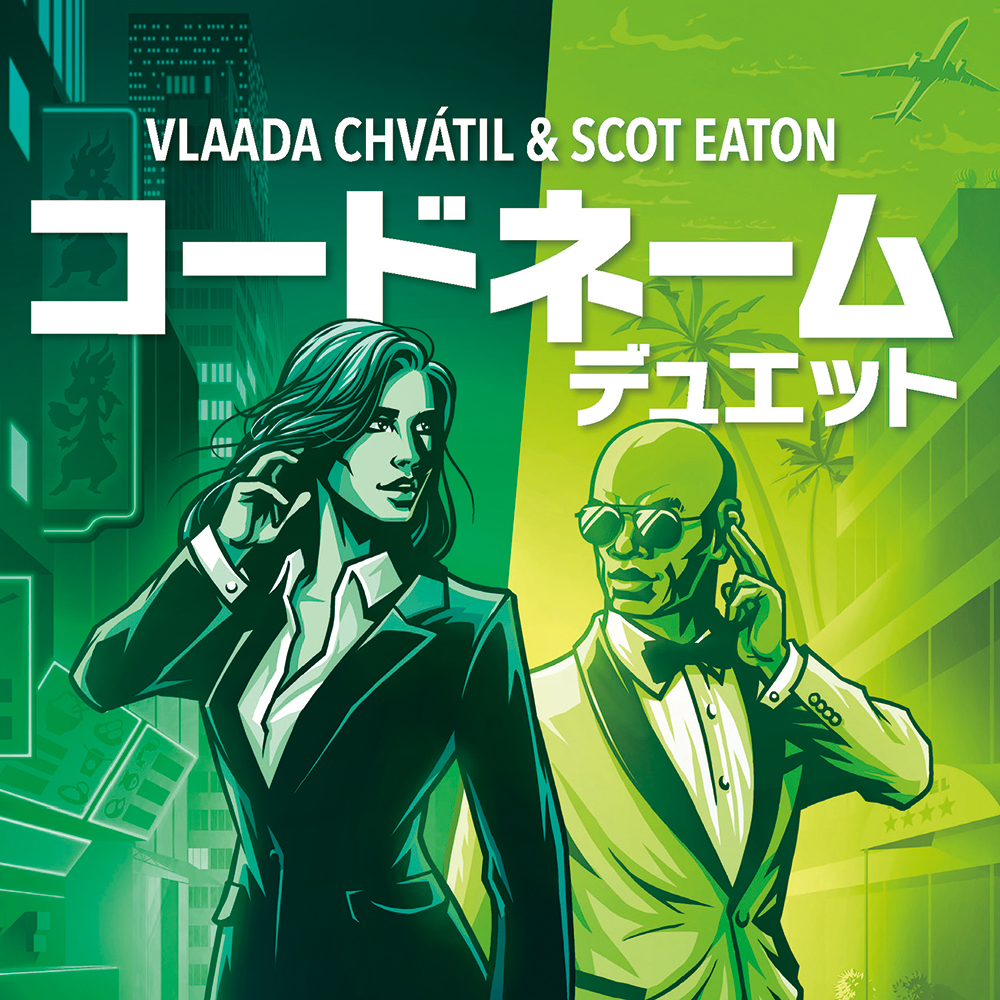
Codenames: Duet | ANALOG GAME INDEX
The beloved 'Codenames' becomes a 2-player cooperative word game!
hobbyjapan.gamesTravel & Cafés: Ultra-Portable 'Tagliron' and 'Onirim'
For maximum portability, the top choice is 'Tagliron'. Gento Sha Educational's specifications confirm 2-4 players, ~15 minutes, 10+ clearly; startup is light, and it doesn't demand much table real estate. Since questioning and deduction occupy attention, you only need enough space for cards—no sprawling board required. Small tables suffice.
The secondary option is 'Onirim'. Hobby Japan and Amazon.co.jp list it as 1-2 players, ~15 minutes, 10+, fitting perfectly into "slip in one round during a break." The cooperative tilt softens confrontation for couples, and fits easily into café breaks or in-transit windows.
Experientially, 'Tagliron' clusters information into a manageable visual footprint, avoiding table-edge sprawl. 'Onirim' is card-based so compact, but organizing deck, discard, and hand clearly increases playability in tight quarters. Both compress into A4-ish bounds. For café-gaming newcomers, our Board Game Café Beginner's Guide clarifies in-venue etiquette so lightweight titles integrate smoothly.
Tagliron / JELLY JELLY GAMES
jelly2games.comCompletely New to Board Games: 1-Minute-Rule 'Stick Stack', Shape-Placement Clarity with Blokus Duo
If "explanation fatigue" is the enemy, your best bet is 'Stick Stack'. The moment you see it, intent becomes obvious; rule-learning happens through one practice turn, not lecturing. Reaction volume beats conversation, so unexperienced pairs feel less pressure to think strategically. Gaming anxiety drops.
Secondary stability belongs to Blokus Duo. Mattel's ruleset confirms 2-player, ~30 minutes, 7+; corner-linking is the only principle needed, then placement teaches strategy. Concrete movement makes "what should I do?" less paralyzing than abstract systems. Strategic depth exists without upfront complexity.
The emotional difference: 'Stick Stack' leads with immediate excitement and group energy. Blokus Duo yields fast comprehension while locking in legitimate confrontation. Lighter opening preferred? Go first. Prefer simplicity with real stakes? Go second. Our Board Game Beginner's Comprehensive Guide explores full-spectrum onboarding logic similarly.
/picture_59486ea7-add5-4a29-8b07-6ccc1714e18e.jpg?2026-03-14-18)
Stick Stack / Stick Stack
Board Game Geek—Comprehensive board game resource with reviews, replays, strategy, and product data.
bodoge.hoobby.netEndless Rematch Energy: Short-Turn Speed and High Replay Value with 'Quarto' and Hanamikoji
When "one game" naturally becomes "best of three," 'Quarto' leads. Turn processing is ultra-fast, resolution comes swiftly, and "just one more" invitations appear instantly. Quick reset plus clear "what changed" analysis makes consecutive play effortless, sustaining momentum through weeknight hours. Fatigue doesn't accumulate.
Secondary nomination goes to Hanamikoji, where personality shifts inform sequential plays differently. Four-action sequencing varies each round, opponent responses diverge, and depth unfolds across multiple rounds. Turns remain brief even as density climbs. Replays don't feel repetitive despite compact time.
Rematch mechanics differ: 'Quarto' excels through sheer speed and recovery. Hanamikoji through variable strategy per session. Both prevent the heaviness that often derails consecutive play. For repeated-play cultures between fixed pairs, our lightweight-competitive and couple-play clusters extend this idea effectively.
Slightly Past 15 Minutes: Masterpiece 2-Player Games Worth the Extra Time
After mastering 15-minute finishers, some evenings call for slightly deeper dives. Games in the 15-30 minute sweet spot offer 2-player exclusivity while adding "build your board," "hold cards," and "explore multiple win routes"—closer to mid-weight satisfaction. Official time extends, but reward deepens tangibly. Four titles anchor this bridge zone:
Patchwork — 2-player exclusive / 20-30 minutes / 8+ | Short form yet profound "shape×time" management
'Patchwork' disguises itself as fabric-quilt assembly but unleashes sharp 2-player combat. Rules: 2-player exclusive, 20-30 minutes, 8+. For players past pure 15-minute quickness, wanting to contemplate "which shape now?" alongside "is this the right moment?" simultaneously, it hits perfectly.
Core beauty: attractive patches tempt you, but the time-track movement creates no universal optimal play. Embedding shapes delivers puzzle satisfaction plus opponent-thwarting spite. Competitive flavor outweighs soft-puzzle impression. You expect lightness, confrontation surprises you.
Against 15-minute quick-hits like Quarto or Hanamikoji (which prize turn sharpness), 'Patchwork' builds boards gradually, widening gaps over sequence. Short-turn cutting-edge trades places with board-accumulation depth. Perfect for 2-player pairs who've tasted lightweight rapid-fire play and want slightly more "game arc" while staying time-conscious.
FAQ | Patchwork Dolls Official Site
azukimochikanoto.wixsite.comSplendor Duel — 2-player exclusive / ~30 minutes / 10+ | 2-player optimization—the classic competitive showdown
'Splendor Duel' represents the refined 2-player remake of a beloved system. Bodoge Geek and Ryusei Games align on 2-player, 30 minutes, 10+. "I want to spend 30 minutes genuinely thinking" pairs find this remarkably clean-fitting.
Base mechanism: accumulate gem tokens, buy cards, build production engines. Duel edition sharpens pressure—competing for colors and board cards stays visceral. Self-building matters, but crippling the opponent's trajectory equally so. Beautiful plans crumble when opponent threads one key move, maintaining constant negotiation.
Compared to 15-minute entries' "best current move" focus, 'Splendor Duel' stretches thinking 2-3 moves forward. Satisfaction deepens from "that was tactical" to "I steered the whole arc." Pairs who love confrontation plus long-term planning (versus pure short-term reading) gravitate strongly here.
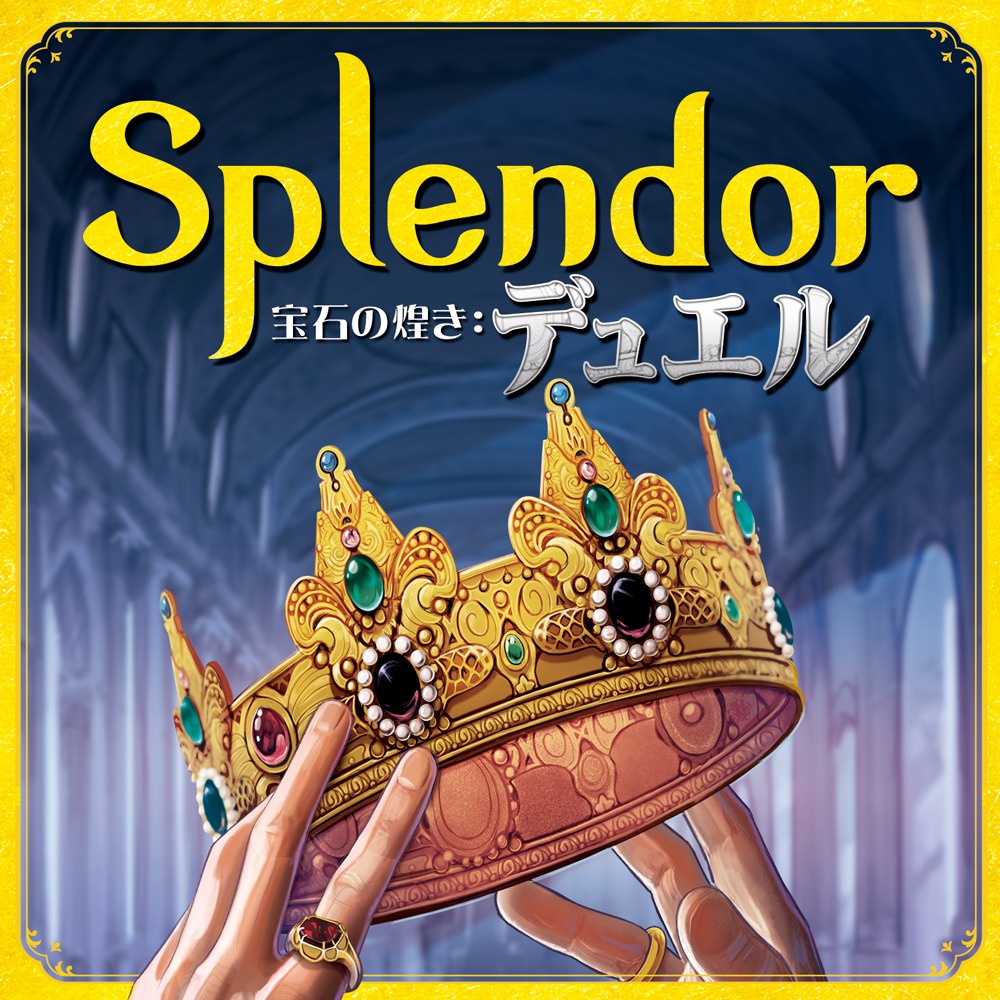
Splendor Duel | ANALOG GAME INDEX
The hit 'Splendor' becomes a cutthroat 2-player engine-building game!
hobbyjapan.gamesLost Cities — 2-player exclusive / ~30 minutes / 10+ | The "play or hold" binary torture chamber
Core tension: "play this now or keep it?" spans 30 minutes of delicious frustration. One action—place or discard—creates multifaceted nasty choices. Hold too long, your hand chokes. Play carelessly, opponent benefits from your discard. Play your own cards openly, so obvious weakness becomes unintended opponent aid. That simultaneous self-sabotage and opponent-feeding dynamic is beautifully evil.
Rules stay lightweight, yet mental struggle stretches time. Card-gamers, especially those liking "painful decision over flashy drama," find this cuts deep. Short official span with extended anguish—arriving exactly where you want to land after 15-minute lightweights prove too shallow but 1-hour games feel too committed.
Play Lost Cities online from your browser
Play Lost Cities online from your browser with the whole world!
en.boardgamearena.com7 Wonders Duel — 2-player exclusive / ~30 minutes / 10+ | The 2-player masterpiece with maximum impact
'7 Wonders Duel' stands as the 30-minute 2-player exclusive where satisfaction dramatically outpaces the time commitment. Civ-building theme partners with multifaceted victory: points alone don't crown victors—military dominance or scientific breakthrough interrupt point races. Same 30-minute window, yet tactical landscape shifts constantly.
Brilliance: what seems open narrows via opponent card selection. Strategic sightlines twist. Card-taking itself becomes psychological theater. Read the board, yes, but anticipate opponent's next three openings too. Density climbs proportionally.
Fit: If you've enjoyed 15-minute games and want "one-step-heavier," Hanamikoji inside the 15-minute band might suit. But '7 Wonders Duel' aims at couples saying "tonight feels like a real game," accepting 30 minutes for deeper arc and multi-layered payload. Splendor Duel is the solid resource-management showdown; this is the nameplate masterpiece experience compressed.
'Patchwork' thrives when approachability-versus-depth contrast reads visually. Soft quilting aesthetic masks tactical depth; showing completed boards alongside mid-game states telegraphs the "looks cute, plays sharp" duality perfectly for article galleries.
'Splendor Duel' registers strongest as 2-player optimization of a famous system. Bright gem tokens and dynamic gem/card interplay communicate mid-weight engagement without overwhelming first-timers. "Upgraded 2-player experience" framing pairs well with visual density.
'Lost Cities' shines when understated aesthetics plus the mental-weight paradox show. Calm card-play photography against emotional decision-making creates compelling contrast; audiences seeking quiet but teeth-gritting play recognize themselves.
'7 Wonders Duel' reads most powerfully as "30-minute masterpiece" where scope outweighs the playtime number. Multiple victory paths, civilization-building theme, and "famous game optimized for pairs" positioning appeal to readers seeking meaty-yet-time-conscious play. Gallery impact remains high.
7 Wonders Duel Official Website|Strategic 2-Player Board Game |Repos Production
sevenwondersduel.comSummary
When in doubt, start with 'Quarto'—short time yet chess-like foresight; beginners choose 'Stick Stack'—explanation-light yet group-warming; serious readers prefer Hanamikoji—compressed show
Related Articles
7 Essential Worker Placement Games for Beginners|How to Choose Your First Game
The appeal of worker placement lies in how shared action spaces and turn order create a natural mind-reading game between players. When you play Stone Age with three people on a weekday evening and someone claims the timber spot you wanted, forcing you to pivot toward hunting and dice rolls—that mix of 'frustration at being blocked' and 'the joy of finding an alternative' is the core of this mechanic.
15 Best Two-Player Board Games | Compared by Type
When it comes to two-player board games, you'll have better luck starting with games designed specifically for two rather than picking whatever's popular. That said, there are multi-player games like Azul and Splendor Duel that genuinely shine as two-player experiences.
10 Best Solo Board Games | How to Choose & How Deep You'll Get
Whether you want a quick 15-30 minute game on a weeknight or a solid 90-minute deep dive on the weekend, solo board games get easier to choose once you narrow things down by whether the game is solo-only or has a solo mode, and then filter by play time, weight, and format. This article breaks down 10 titles — including Onirim, Under Falling Skies, and Coffee Roaster — in a clear, side-by-side way.
Best Board Games for 3 Players — Standout Titles Built for Bluffing and Negotiation
Finding the right board game for three players isn't just about headcount. Three-player games occupy a sweet spot — more tension than a two-player duel, tighter reads than a four-player free-for-all — where "who do I stop right now?" and "when do I swoop in for the win?" become genuine strategic questions.