
10 Best Heavy Board Games for Intermediate Players Ready to Level Up
10 Best Heavy Board Games for Intermediate Players Ready to Level Up
If you're curious about heavy board games but can't decide where to start — too many acclaimed titles, too little guidance — this guide cuts through the noise. We rank 10 heavyweights including Terraforming Mars, Power Grid, and Istanbul Big Box across three practical axes: ease of entry, learning curve, and player count fit.
Plenty of intermediate players are genuinely curious about heavy board games but end up frozen — too many acclaimed titles, no clear place to start. This guide zeroes in on 10 heavyweights, including genre staples like Terraforming Mars, Power Grid, and Istanbul Big Box, filtered through three practical axes: ease of entry, learning curve, and player count fit.
Heavy games aren't just about long play times. What makes or breaks a first session is knowing which concepts you actually need to grasp upfront. We'll use BGG Weight as a reference, but the real focus is the specific "first-session stumbling blocks" our editorial team encountered across 3–4 player regular sessions and 2-player evenings — along with how to sidestep them. By the time you finish reading, you should be able to narrow your shortlist to three candidates that actually fit your table.
Where Do You Start with Heavy Games? A Guide for Intermediate Players
The line between "medium" and "heavy" isn't a single threshold. A practical rule of thumb: 60+ minutes is the entry point, 90+ minutes is the main territory. Add 30+ minutes per player and 15+ minutes just to explain the rules, and you're firmly in "this feels heavy" territory. A 60–90 minute game on a weeknight tends to leave enough room to finish and talk through it afterward. A 2-hour game on Saturday, though, demands that you stay focused from the opening turns and pace your concentration all the way to the end. Whether something counts as a heavy game depends less on the box art and more on how much of your brain it occupies at that time of day.
BGG's Weight rating is handy, but it's a community-voted complexity metric — it shifts over time, and subjectivity is baked in. For an intermediate player picking their next game, the number itself matters less than two questions: how many core concepts do you need to understand in game one? And can you tell what to do on your own turn? Take Ark Nova: 1–4 players, 90–150 minutes, and first-timers should budget around 2 hours 15 minutes to 4 hours including setup and rules. The heaviness isn't just the play time — it's the need to simultaneously parse card text and manage action card ordering. Contrast that with games where the board looks complicated but the turn structure is "move, place, take." Those often feel lighter in practice than they look.
Jumping straight to ultra-heavy games leads to burnout for exactly this reason: the number of concepts you need upfront multiplies fast. But the hurdles aren't only about rules. You need to block off a long stretch of time, setup takes real effort, prices trend higher, and finding people who want to commit to the same game is genuinely hard. The deeper the game, the more likely it is that the payoff only clicks on the second or third play — the first one is mostly orientation. Our editorial team has been there: tackling a big game out of the gate often meant the cognitive cost arrived first and the fun came later. That's why for intermediate players, 60–90 minute games where "what this turn accomplishes" is legible tend to serve as better springboards than headline 2-hour epics.
If the genre terminology is getting in the way, a quick glossary helps: Worker placement means placing worker tokens to claim action spaces before opponents can. Engine building refers to games where early investments in production pay off exponentially in the mid-to-late game. Area control means competing for territory or influence on a map to score points. Deck building means strengthening your card pool during play so that each cycle gives you more options. Where your excitement lands in that list points toward which type of heavy game to try next. Agricola is the classic worker placement example; Scythe leads with map tension and the satisfaction of expanding your engine.
For concrete examples, the games that work best as stepping stones tend to have one clear strategic axis. Concordia (2–5 players, 90 minutes) builds economic intuition around card management. Brass: Birmingham (2–4 players, 60–120 minutes) is a dense network and industry game — first-timers should budget around 2.5 hours including rules. Great Western Trail 2nd Edition (1–4 players, 75–150 minutes) rewards the feeling of deck and engine clicking together over each circuit. All of these lean heavy, but none throw every element at you with equal weight at once. They're ideal for learning the grammar of heavy games.
Starting with fewer players also makes sense. More players means more board-state updates to track and more recalculating between your turns — not just more discussion and Downtime. Scythe plays at 1–5, but it gets noticeably longer with more people, and first sessions can stretch significantly. With 2 or 3 players, it's much easier to follow what winning lines look like and recognize when you're being squeezed. Thinking of heavy games not as "games with difficult rules" but as games that require you to manage information flow makes the player count decision much easier to reason about.
For further reading on how the 90-minute threshold is defined, resources like the Kyodai Board Game workshop's heavy game introduction explain why the boundary is fuzzy. Understanding what BGG Weight actually measures — and what it doesn't — helps contextualize the numbers. If you're thinking about how to run rules explanations efficiently, tips on delivering a clear rules explanation (Rules explanation) pair well with that.
The question of how to use medium-weight games as a bridge to heavy ones is tied directly to this topic. Whether you've spent time with 60–90 minute games where the strategic spine is visible has a real effect on how easily you'll enter something like Concordia or Great Western Trail 2nd Edition. Players who've already learned where to direct their attention on a weeknight game tend to maintain focus better when a 2-hour game starts demanding more of them.
Three Criteria That Keep Intermediate Players from Making Mistakes
The ranking criteria here aren't simply "is this well-reviewed?" Intermediate players don't usually stumble because a game lacks quality — they stumble because the upfront learning cost and the practical overhead of getting it to the table don't match what they expected. Our editorial team evaluates each game across three dimensions: learning curve, operational reality, and time fit. These same axes — player count, play time, age rating, difficulty, BGG Weight estimate, price range, best player count, first-session rules explanation notes, and who it's for and not for — appear consistently in the short reviews for each title below.
Learning curve is the first dimension. The fewer core concepts you need to internalize in game one, the more accessible a heavy game becomes. Concordia (2–5 players, 90 minutes, 12+) has a lot going on visually, but each turn essentially asks one question: which card do I play? That keeps your focus from scattering. Ark Nova (1–4 players, 90–150 minutes, 14+) runs card interpretation and management of five action cards at different intensity levels simultaneously. The weight isn't the volume of rules — it's that it's hard to know where to start understanding. Our team measures this gap not by rule count but by "how clearly can you see your options when your turn arrives?" Three viable choices visible at turn start is friendly. Equally important: does the game have a clear round structure? When you can see where the break points are, what gets updated, and what you need to prepare for — you can actually plan ahead, even in game one.
Operational reality is the second dimension, and it's the most frequently overlooked one before purchase, despite having an outsized effect on satisfaction. Player count compatibility is a prime example. The same well-reviewed game can feel completely different at 2 players versus 3–4. Concordia shifts in feel based on table density — it tends to suit evenings where you want to optimize quietly. Power Grid, with its auction and resource market as the central experience, gains pressure and character as player count rises; at 4 players, the game really opens up. At 2 players, the bones of the design are clear, but the market turbulence and reading-your-opponent depth feel calmer. Whether a game is best at 2 or truly shines at 4 matters — a ranking that skips that distinction loses practical value.
Setup and teardown overhead matters too. Scythe is listed at 60–90 minutes for 1–5 players, but in practice a first session is less a casual weeknight game and more a "we're committing to this evening" experience. Brass: Birmingham (2–4 players, 60–120 minutes, 14+) similarly warrants budgeting around 2.5 hours for a first session to feel comfortable. These games have a psychological hurdle that's separate from their quality. That's why this guide also factors in price and availability. Whether the Japanese-language edition has stable distribution, and whether the price feels proportionate to the content, are real conditions for intermediate players making their next purchase decision. Scythe is listed at approximately 11,550–12,100 yen (~$75–80 USD) on Arclight's page; Brass: Birmingham at around 9,020 yen (~$60 USD); Ark Nova's Japanese edition is listed at 9,900 yen (~$65 USD). Concordia has been found at around 4,000 yen (~$26 USD) on price comparison sites, which makes it unusually accessible for a game of its caliber. We also ask: does the base game provide enough depth on its own? Games where the base box gives you a complete strategic picture are far less likely to disappoint at the entry stage.
💡 Tip
The more acclaimed the game, the more expansion content tends to appear in discussions around it. But for intermediate players approaching a game for the first time, asking "how many times will I want to play the base game?" is more diagnostic than asking about expansions. It's the better test of whether the game is actually a fit.
Time fit is the third dimension — not just total play time, but where in your life the game can realistically live. Games that fit within 90 minutes open the door to finishing a full game on a weeknight and still having time to discuss it. Istanbul Big Box often comes up as a more accessible entry point precisely because each turn has a clear purpose and the 40–80 minute window bridges medium-weight and heavy-weight games comfortably. Games like Ark Nova, Great Western Trail 2nd Edition, and Agricola that push toward the 2-hour range are better thought of as weekend centerpieces. Ark Nova at 3 players in a first session can run 2 hours 15 minutes to 4 hours including rules — the "weight" manifests as both cognitive density and time commitment. GWT2 runs 75–150 minutes, tightening to 90–120 solo while stretching to a full 150 minutes at 4 players. Agricola similarly warrants budgeting 2–3 hours for a first session.
Time fit also intertwines with competitive versus cooperative preference. In a competitive heavy game, Downtime and constant board updates affect how long the session feels, and in cooperative games, deliberation fatigue becomes a different kind of drain. A ranking for intermediate players needs to distinguish between "long but immersive" and "long and each turn is demanding." Two games with similar time and player counts can have very different actual experiences. If you're thinking through the purchase decision holistically — budget, who you're playing with, storage — the framing in a first-purchase guide for board games covers a lot of overlapping ground.
Top 10 Heavy Board Games
This ranking weighs "is this game easy to bring to the table, despite being heavy?" alongside pure difficulty. First-session accessibility, player count fit, and how the play time resolves in practice all factor in. Different sources define "heavy" differently, but for an intermediate player choosing a next game, looking at both rules weight and table practicality together tends to prevent regrets.
Terraforming Mars
The gold standard for making engine building and card combo satisfaction feel accessible. The interplay between asymmetric corporations, the card draw element, and map area development gives every game a different growth path. Among heavy games, the answer to "what makes me stronger here?" is relatively visible — which is precisely why this title keeps appearing as a recommended entry point.
Best for people who enjoy growing a personal engine while reading card effects. Less ideal for those who find long card text tedious or who want complete-information chess-like clarity over any luck elements. Ideal session setup: 3–4 players in a regular gaming evening, where everyone builds their own board while keeping an eye on others.
1–5 players / 90–120 min / Ages 12+. Difficulty: heavy game entry level. Best at 3 players — you get enough competition and market movement without the Downtime stretching. First-session rules explanation note: don't try to explain every card's individual effect. Lead with the three pillars — "increase resources," "advance temperature, oxygen, and oceans," "understand how victory points enter the game" — and the rest follows naturally.
Power Grid: Recharged
A classic economic heavy game where power plant auctions, resource market pricing, grid network expansion, and income management all flow into one coherent system. Skilled players have a clear edge here, but that gap is visible — which makes this an excellent learning vehicle for understanding economic games. As you internalize it, the depth only increases.
Best for people who enjoy auction dynamics and reading market conditions. Less suited for those who find it frustrating when other players' choices constrain your options without direct conflict, or for those who aren't excited by number management over thematic immersion. Ideal session: 4–5 players at a regular gaming evening, or any night where economic game fans gather. More players tightens the market, and the game's personality sharpens.
2–6 players / 120 min / Ages 12+. Difficulty: heavy, with an economic lean. Price range was not confirmed in our data. Best at 4 players — the resource market pressure and turn-order reading reach their most satisfying balance here. First-session rules explanation note: show the full round structure before diving into any single phase. Explaining the auction alone, then resource purchasing alone, then construction alone makes the overall loop hard to grasp. Share the sequence — auction → resource purchase → building → income — up front, then explain the "why" behind each step.
Istanbul Big Box
An excellent bridge from medium-weight to heavy. The core structure — placing and collecting your merchants as you efficiently circuit the market — has clarity that keeps you oriented even when the board looks busy. Big Box's expanded content adds range, but the base appeal is solid enough to make it an effective heavy game introduction.
Best for players who like turns with a defined goal, or who want optimization without overwhelming complexity. Not for those expecting big combos or dramatic swings every turn. Ideal session: groups with mostly medium-weight experience, or weeknight gaming where you want to think hard without a long time commitment.
2–5 players / 40–80 min / Ages 10+. Difficulty: upper-medium to heavy entry. Price range was not confirmed in our data. Best at 3–4 players — you get meaningful competition over board positions with good pace. First-session rules explanation note: don't have players memorize individual location effects before starting. Lead with the skeleton — "collect your merchants" and "rubies are the win condition" — and the specifics come naturally during play.
Blood Rage
A confrontational game that packages drafting, area battles, and power unlocking into a bold Norse mythology theme. It looks like a pure fighting game, but card selection and understanding your scoring routes matter enormously — and deliberately losing a battle can be profitable in the right circumstances. As battle-oriented heavy games go, the core rules are clear and the table presence is strong.
Best for players who engage positively with direct conflict and like building strategy through drafting. Not suited for those who dislike having their board presence disrupted, or those looking for quiet optimization. Ideal session: 4 players who want to both think hard and have a great time — the draft pivots are always rich conversation material afterward.
2–4 players / 60–90 min / Ages 14+. Difficulty: upper-medium to heavy. Price range was not confirmed in our data. Best at 4 players — area competition and draft pressure reach their sharpest form. First-session rules explanation note: communicate early that "fighting to win territory" is not the only path. Quest completion and deliberate losses can both generate points, and players who don't know this tend to play a simple brawl game and miss what's actually interesting.
Concordia
An elegant economic game of expanding trade routes across the Mediterranean through sequential card play. Rather than spectacular special abilities, the game rewards the precision of knowing which card to play, when to play it, and when to reclaim your hand. The more you play it, the better it gets. Remarkably clean for a heavy game, with a satisfying clarity in searching for the right move.
Best for players who enjoy quiet interaction and long-horizon optimization. Not for those who want a big dramatic moment each turn or expect flashy card effect chains. Ideal session: 3 players or so, minimal chatter, full concentration — this game rewards a calm table.
2–5 players / 90 min / Ages 12+. Difficulty: upper-intermediate leaning heavy. Available in Japanese through New Games Order; price comparison sites have shown it around 4,000 yen (~$26 USD). Best at 3 players — the board density hits a sweet spot, not too tight, not too loose. First-session rules explanation note: convey the scoring logic early. Explaining actions without explaining what you're building toward leaves players without a compass. Letting them know that the card types they buy directly define their scoring paths gives every decision meaning.
Scythe
Set in an alternate-history Europe, Scythe looks like a war game but weights resource management and action efficiency far more heavily than combat. Mechs and heroes carry real presence, but most turns are about optimizing your own player board — the world-building and strategic depth balance each other well. It's a game with conflict, but not a game that's always fighting.
Best for players who want a thematic heavy game, or who enjoy the combination of managing your own faction and navigating external pressure. Not for those who are put off by the presence of direct combat (even though it's less frequent than it appears), or for those expecting a combat-first experience. Ideal session: 3–4 players on a weekend, giving the game the starring role — the table presence is strong enough to anchor a dedicated gaming day.
1–5 players / 60–90 min listed / Ages 14+. Difficulty: heavy. Japanese complete edition is listed at approximately 11,550–12,100 yen (~$75–80 USD) on Arclight's page. Best at 3–4 players — the breadth and tension feel right, and Downtime doesn't become excessive. First-session rules explanation note: before explaining combat rules, make sure everyone understands the top-action and bottom-action pairing system. The game's appeal lives in how you run your board, not in whether you fight.
Brass: Birmingham
Among economic game classics, this one has an unusually tactile quality. Industrial tile building, network formation, resource consumption, and the Era transition interconnect with precision — and reading several moves ahead produces real satisfaction. It doesn't announce itself with flashy mechanics, but the weight of each individual decision pulls you in.
Best for players who love interdependent economic strategy and find joy in planning around other players' infrastructure. Not ideal for those who want to do anything freely from turn one, or who need a satisfying moment before they've internalized the rules. Ideal session: 2–3 players, high-density thinking, the kind of table where the post-game conversation is part of the experience.
2–4 players / 60–120 min / Ages 14+. Difficulty: heavy. Arclight's Japanese edition is listed at approximately 9,020 yen (~$59 USD). Best at around 3 players — enough mutual interaction to keep the board alive, while the overall arc stays legible. First-session rules explanation note: show the Canal Era vs. Rail Era distinction early. Without that, players' early building intentions won't land. Rather than walking through individual building effects, lead with the cycle: "connect, sell, flip, score." That loop is everything.
Ark Nova
One of the defining modern heavy games. Built around zoo management as a premise, it takes card synergy and action intensity management to an extraordinary level. The positioning of your five action cards determines the rhythm of your entire game — raw collection of strong cards isn't enough to win. There's a lot to do, but it all connects back to your winning path.
Best for players who love assembling a unique engine from a vast card pool. Not for those who find dense card text draining, or who want quick, tense conclusions. Ideal session: 2–3 players with a half-day block on a weekend. First sessions with 3 players including rules explanation can run 2 hours 15 minutes to 4 hours, so save this for a day where one game is the whole plan.
1–4 players / 90–150 min / Ages 14+. Difficulty: heavy. Japanese edition list price has been confirmed at approximately 9,900 yen (~$65 USD). Best at 2–3 players — Downtime stays reasonable and card reading stays manageable. First-session rules explanation note: don't treat every card as a special case. Get the skeleton across — "play animal cards," "advance conservation," "action cards further right are stronger" — and game one runs fine from there.
Great Western Trail 2nd Edition
Deck building, route building, and building placement folded naturally into a cattle drive circuit structure. Each lap grows your deck and board presence incrementally, and the same route offers different decisions every time around. The 2nd Edition improves both visuals and accessibility, making this an easy recommendation right now.
Best for players who want to build up a deck while also extracting efficiency from the board. Not for those who find it cumbersome to manage route optimization and card strategy simultaneously. Ideal session: 2–3 players settling in for a strategic game. Solo compatibility is strong too, so it earns table time even outside dedicated competitive gaming groups.
1–4 players / 75–150 min / Ages 12+. Difficulty: medium to heavy. Arclight's page has shown prices around 7,480–8,580 yen (~$49–56 USD). Best at 2–3 players — Downtime stays reasonable and your development arc stays visible. First-session rules explanation note: frame it upfront as "a game you get stronger at over multiple circuits." Getting people focused on the loop — deck plus buildings clicking together — rather than searching for individual optimal moves brings the fun forward faster.
Agricola Revised Edition
The defining worker placement game, where the tension between feeding your family and expanding your farm is sharp and relentless. Early game you always want more actions than you have; late game your farm finally starts coming together. Where other heavy games seduce with flashy mechanics, Agricola holds you through the urgency of every single decision.
Best for Worker placement fans who find meaning in solving difficult early-game situations through clever play. Less suited for players who want comfortable, sprawling expansion, or for those who experience food pressure as stress rather than puzzle. Ideal session: 2–3 players, quiet and focused — card combinations and action-space racing reward concentration over conversation.
1–4 players. Age rating was not confirmed from available box information. Play time is not confirmed in our data, but first sessions should budget 2–3 hours including rules. Difficulty: the defining heavy worker placement game. Best at 2–3 players — the balance of board competition and Downtime is right here. First-session rules explanation note: get the food cycle across before any card effects. Show the three harvest steps — field harvest, feeding, breeding — before anything else. Without that, early decisions feel arbitrary. Explain early why gaining a family member is as big as it is. And give players permission to just play one occupation card that looks useful rather than reading every card before the game starts. The game's soul is in running the farm on limited actions, not in mastering card text.
Terraforming Mars
1–5 Players / 90–120 Min / Ages 12+. Difficulty
Terraforming Mars is the heavy game entry point that's hardest to argue against. Asymmetric corporations, a massive card pool full of variety, and the satisfying momentum of engine building — resources compounding into bigger turns — are all packaged into a theme that doubles as a turn-by-turn instruction manual. Many heavy games obscure "what makes you stronger"; here, terraforming Mars itself shows you where to act, which keeps first-session analysis paralysis to a minimum.
Our editorial team recommends this for intermediate players because the objective is unusually clear for a game this heavy. Raise temperature, increase oxygen, place oceans, grow income, chain card tags — these multiple goals don't scatter in different directions. They feel like one integrated management picture. If you love card combos, the payoff of a modest early investment blooming in the mid-game is exactly what this delivers.
Best at 3–4 players, where competitive energy and market dynamics balance well without anyone getting lost in the crowd. 2-player and solo are also genuinely good, especially for learning purposes — with fewer players you can trace engine formation and tag synergies at a comfortable pace. Works well as a couples' weekend game or as the main event at a 3–4 player regular session.
The game suits engine builders and long-hand planners. Direct aggression and forced interactions aren't the core here — it's more "race to develop faster" than "actively disrupt opponents." The map territory grab and milestone race do create meaningful competition, but the feeling is competitive development rather than sabotage.
For first-session rules explanation: get these three things solid before the first card is played — the two-action-per-generation flow, income processing at generation end, and card tag management. Ambiguity around these means card-specific interest never gets to surface because players are stuck on process. Also decide upfront whether you're using the draft variant — drafting adds reading-your-opponents depth and a more competitive edge; without it, accessibility increases. For an introductory table, simply dealing cards out and playing works perfectly well.
💡 Tip
Terraforming Mars is unusual among heavy games in that "I'm building my company" is legible from turn one. Resources accumulate, cards click into place, Mars itself develops — the effort and the reward don't feel separated.
For baseline specs, cross-reference official distribution or product pages for player count and time, then use BGG-adjacent sources for complexity reference. Different resources define "heavy" differently — 138GAMES uses "30+ minutes per player and 15+ minutes for rules explanation" as a threshold; Kyodai Board Game's intro guide uses 90 minutes as a rough marker. Within that landscape, Terraforming Mars consistently lands on the "heavy but accessible" side.
BGG Weight is useful as a relative indicator — think of it as showing how complex experienced players find it, not an absolute difficulty score. Terraforming Mars reads as upper-medium to heavy-entry by the numbers, but in practice the accessible theme and clean engine building logic make it feel friendlier than those numbers suggest.
『テラフォーミング・マーズ』
テラフォーミング・マーズ 完全日本語版 - ArclightGames Official
ご購入はコチラから! メーカー:FryxGames デザイナー:Jacob Fryxelius 原題:Terr
arclightgames.jpPower Grid: Recharged
Power Grid: Recharged remains the benchmark economic heavy game. Power plant auctions, resource market fluctuations across coal, oil, and other commodities, and network building as you connect cities — all of it funnels into one coherent flow. When an intermediate player thinks "I want something with real economic weight next," this game is worth the investment. It doesn't overwhelm through sheer rule volume — instead, the feedback loop between market movement and your own decisions is direct and legible, which makes it an ideal foundation for understanding economic game design.
The game is at its best with 4–5 players. More players means power plant auctions get genuinely brutal, and resource markets spike fast when someone corners a commodity. Turn order creates an interesting twist: later-turn players get a construction advantage, but pay higher prices for resources. The result is that no position is simply "better" — turn-order tension creates the oscillating pressure that makes the whole table feel alive. At 2 players, that pressure softens considerably, and the market turbulence and read-your-opponent depth that define this game's best moments tend to stay muted.
What makes each session compelling is how every decision chains into every other decision. Overpaying in the plant auction might crimp your resource purchases later. Stockpiling resources early might leave you short on cash for city connections. Rushing expansion can grow your income potential while your actual generation capacity lags behind. Local optima aren't global optima — the game is structured this way on purpose. That's why it keeps appearing in "essential economic games" lists.
Best for players who enjoy auctions and market reading. Reading what your opponents want, deciding whether to inflate a resource price, knowing when to let a plant go — those micro-decisions are where the fun lives. Less suited to players who want dramatic direct conflict or sudden reversals. Comebacks aren't impossible, but wins tend to emerge from better financial planning across several rounds, not from one decisive blow.
For rules explanation, show the round structure skeleton before explaining any single phase. The specific sequence — auction → resource purchase → building → income — should be the first thing everyone understands, followed by explaining why that order matters. Auctions come first, which strains your cash and makes resource purchase harder. Building comes after resources, so your current generation capacity and future expansion are always in tension. Income lands at round end, so today's overreach has visible consequences next round. The order is the game's design, so it's worth communicating clearly — a visual aid or pointing to the board as you explain works well here.
The other common first-session stumbling block is resource price movement. In Power Grid, the market doesn't just go "expensive" or "cheap" — as players buy resources, cheaper slots fill up and prices get pushed upward. This is hard to grasp through verbal explanation alone. Walk players up to the actual resource track and show it: "if I buy 2 coal right now, the next player starts from here." Watching the price physically shift makes the strategic depth of market reading click immediately. The goal is a shared visual picture of prices moving, not price memorization.
💡 Tip
Trying to teach Power Grid as an auction game undersells it; teaching it as a network game also misses the point. Frame it as "a game about reading where the money is going" and suddenly the auction, the market, and the network all make sense as one coherent system.
Classics can feel dated in feel. Power Grid: Recharged doesn't — its lessons remain current. Learning price intuition through the auction, reading supply and demand through the resource market, understanding the compounding value of network expansion in long-horizon planning — all of this applies to economic games broadly. If Terraforming Mars is an entry point for engine building, Power Grid is the natural entry point for economic heavy games. Its continued appearance in heavy game roundups isn't just brand recognition — it's because the structural integrity of the design is still clearly audible when you play it today.
『電力会社 充電完了!』
Istanbul Big Box
Istanbul Big Box is deceptively well-organized for how complex it looks. For someone who's enjoying medium-weight games but finds the jump to Brass: Birmingham or Ark Nova a bit intimidating, this game hits exactly the right midpoint. The board is busy and options look wide, but what you're actually thinking about each turn is "where do I move, and how do I place and collect my merchants?" That single axis keeps you from getting lost, regardless of how much is on the table.
3–4 players is where the game shines brightest. You get genuine competition over market spaces and location effects while Downtime stays reasonable. At 3 players, routing decisions are cleanly visible; at 4, the race to grab valuable spots heats up and the value of move order jumps noticeably. 2-player tempo is also solid — the crowding relaxes, but you gain clearer ownership of your routing plan, which lets you think through "if I take this path, I'll reach my next ruby" with satisfying precision.
What makes Istanbul work as a heavy game entry point is that it sidesteps one of the most common first-session problems: "too many choices, no idea what I'm building toward." The win condition — collect rubies — is explicit. Every other action on the board connects back to it. Building money, gathering goods, upgrading your cart, acquiring abilities — individually they look scattered, but they all converge on rubies. Our editorial team believes that for heavy game entry, clarity of purpose matters more than variety of options, and Istanbul consistently delivers that.
Best for people who enjoy planning efficient board circuits. The pleasure here isn't in one big flashy combo per turn; it's in noticing that "if I place my merchant here now, I'll be able to use this space next lap" and "this detour looks slow but actually accelerates my next pass." Turn processing is relatively fast, which keeps table rhythm healthy. Those who want to dig deep into multi-card combo chains each turn may find it a touch light. The thinking is real, but it's route optimization and action sequencing rather than ability-layering.
For rules explanation, resist the urge to front-load building effects. Instead, open with "first player to collect the required number of rubies wins" as the target, then show the core turn structure: "move to a location, then either use the effect there or collect your merchant if you left one." Once those two things are understood, the board starts making intuitive sense. Dense-looking games are tempting to teach comprehensively, but Istanbul rewards the opposite approach — a sharply defined skeleton with details learned through play. In our experience, as long as players grasp "this is a game of moving and merchant management," the rest fills in during the game without explanation.
💡 Tip
Rather than teaching Istanbul as "memorize what each building does," frame it as "a game of developing your circuit." Once players see connections as lines rather than destinations as points — "this sequence is fast" — the game's appeal unlocks.
The description of Istanbul as an entry-level heavy game appears across multiple sources for a reason. The weight here isn't about exception-processing — it's about the efficiency gap between turns compounding over time. Play long enough and you can clearly see that the better player is taking fewer wasted steps. That "getting better at the thing" feeling shows up quickly and stays satisfying. For players who want to discover strategic planning as the interesting part before they encounter long play times as the interesting part, this is a strong first choice.
『イスタンブール BIG BOX』
Blood Rage
Blood Rage's strength is packing a full, dense competitive-game experience into 60–90 minutes. Area control games often run long, but this one maintains real board tension, card reading, and battle tactics within a relatively contained play window. Among heavy games, if you're more interested in "how do I outmaneuver my opponent right now" than in stacking an economic engine or building a production loop, Blood Rage delivers that with clarity.
3–4 players is the target range. Each area on the board faces genuine threat, and every round forces real decisions about where to press and where to concede. At 4 players especially, quest rewards and battle locations naturally collide, which means reading the draft isn't just about card strength — you also need to model what your opponents want to fight over and when. At 3 players the picture clears slightly, making it easier to follow tactical intent, which actually helps first-timers find the fun faster. 2-player is a different experience with its own appeal. The board chaos softens, but reading your opponent's hand tendencies and projected movements becomes sharper and more central. If you're expecting the multi-player free-for-all energy, 2-player will feel like a different game — but as a tight, read-heavy competitive game it works well on its own terms.
What makes this suitable for intermediate players isn't simplicity — it's tactical density. Each age you draft cards, deploy units, trigger battles, and eventually watch Ragnarok collapse regions. The sequence is easy to follow; the decisions within it are genuinely hard. Winning doesn't mean dominating territory — it means deliberately losing specific battles, sending units into certain destruction, and making choices that look counterintuitive from the outside but pay off in ways only you anticipated. "The side that fights doesn't always benefit" is what gives this game its depth.
Best for players who enjoy games where the table heats up competitively. From the draft phase onward, every pick is a question of "do I take this upgrade or keep it from my opponent?" On the board, you're simultaneously choosing when to advance and managing hidden card reveals in battle. Upsets are common and the satisfaction when your read lands is real. Less suited for players who prefer building their own board undisturbed or who have genuine resistance to being directly attacked — units being removed is core to how the game works, and value is embedded in that removal.
For rules explanation, don't open with individual card effects. Start by walking everyone through the full sequence — draft → deployment and battle → Ragnarok — as a single continuous picture. Players who don't understand what they're competing over before card explanation starts have no frame to attach the information to. The piece that deserves the most care is simultaneous battle card reveal. This isn't simply "higher strength wins." What cards you play face-down, and which you keep back, changes both the outcome and the rewards. In our experience, framing the battle system as "the uncertainty before reveal is the game, not just the resolution" lands faster than walking through the mechanical sequence.
💡 Tip
Blood Rage lands better when described as "a game of executing the plan you built in the draft through battle moments" rather than as an area majority game. The board looks aggressive; the actual decisions are surprisingly nuanced.
Short game, but lasting impression. Each round's conflict is self-contained, and Ragnarok forces the game forward so it never drags. The feeling that defines this game isn't "accumulated right choices" but "a small number of big read-the-room moments." One game ends and you're already thinking about the next draft. For intermediate players who want competitive tactical intensity rather than economic depth or engine building, this is a strong pick.
『ブラッドレイジ』
Concordia
Concordia's strategic depth is wildly disproportionate to how simple its rules are. Intermediate players who've avoided heavy games because of exception-heavy rules or "you need to know every card to have a chance" complexity will find that fear completely disarmed here. What you're actually doing — moving across a Mediterranean map, building houses, securing resources, buying cards — is straightforward. But which order you develop things in, and how you weight each axis, creates real personal style.
The most distinctive thing about this game is that card purchases simultaneously define your scoring conditions. In most engine builders, "cards that strengthen my engine" and "cards that score me points at the end" are different categories. Concordia elegantly collapses that distinction. Buying the action card you want is also a declaration of which scoring axis you're committing to. This means that from the midgame onward, each turn isn't just efficiency optimization — it's sharpening the outline of your end-game plan. The rules phase looks unassuming; the post-game board state clearly shows every player's strategic fingerprint.
3–4 players is the sweet spot. At 3, map density and freedom balance well — it's legible who's going where, which makes the read-your-opponents layer accessible. At 4, competition for building locations and resource supply tightens, and that crowding converts into interesting pressure rather than frustrating blockage. 2-player is sharp and demanding. Reading your opponent precisely, pre-empting their locations, playing a tighter overall game — it works, but it's a game that opens up more after you know it well. First-timers who want room to develop their strategy are better served at 3.
Best for players who enjoy transparent strategic thinking. The board doesn't flip through spectacular ability effects — the gap between players opens slowly from public information. "Why I lost" and "what they did well" remain legible after the game ends, which is exactly what makes it replayable. Our editorial team's experience is that games where the post-game naturally generates "I'd try a different development path next time" become durable favorites. Concordia is exactly that kind of game — every session's mistakes convert cleanly into next session's opportunities. Players who want dramatic ability combos or theatrical reversals will find this game too quiet. It builds through small nods of "so that's where you went" rather than table-erupting moments.
The most important first-session rules explanation concept is the "play all cards before retrieving" rhythm. If this is vague, players assume they can pick any action every turn, and the hand management tension that defines Concordia disappears. The bind between "I want to act now" and "I need to consolidate for retrieval efficiency" is where the interesting decisions live. Also worth introducing early: the Goddess card scoring system. Framing it as "what you build determines what scores" rather than "what earns me money" immediately gives early building and movement decisions meaning.
💡 Tip
Describing Concordia as a trade game or area control game undersells it. "An economic game where the rhythm of your hand is the strategy" captures it better. Few action types, but the decision of when to retrieve changes your entire plan — that's the core.
Individual turns are fluid, the board is readable, but the scoring spread at game end is consistently surprising. That gap isn't arbitrary — it traces directly back to early decisions, which makes it feel earned rather than random. Among heavy games, Concordia is a priority pick for players who want to experience the pleasure of strategic construction more than "surviving complex rules."
『コンコルディア』
Scythe
Scythe pulls off something rare: engine building satisfaction and map tension, both at a high level, in the same game. Intermediate players moving toward heavier games sometimes find that pure economic games lack presence, while pure conflict games feel more exhausting than rewarding. Scythe lands squarely between those extremes — you get both "I'm growing my faction" and "the map changes meaning because of where other players are."
The map is large, but the play experience isn't simple warfare. The real core of the game is how you run your player board to chain resources, movement, and deployment. Top-action board management followed by bottom-action upgrades and deployment — when those start clicking, each turn suddenly feels valuable in a different way. Then the pressure from moving toward the center, encounter cards, and positional threats layers on top. The result is neither a pure sandbox nor a pure conflict game. That "I'm building my engine, but I'm never not watching the map" quality is what makes Scythe stay in your memory.
1–5 Players / 90–115 Min / Ages 14+. Difficulty
4 players tends to produce the experience most associated with this game. Natural attention spreads across the map's directions, central pressure doesn't concentrate on one player, and the "one person just does whatever they want" outcome is rare. 2 and 3 players are better for learning — they're good environments for understanding how to run your action board and sequence resource development. The trade-off is that map tension softens. 5-player density is genuinely interesting on the board, but this is a game where players can think deeply, so Downtime lengthens noticeably — best saved for a day where everyone's committed to one game.
Best for players who've outgrown medium-weight games and want something with genuine board presence. Players who like Concordia's clean design but want a bit more map weight and territorial tension will connect with this. Not quite the right fit for players who want to develop in isolation without other factions' plans affecting them — even though direct combat is infrequent, the game is fundamentally shaped by "other players' positions always mattering on the map."
For first-session rules explanation: alongside the action structure, share the faction board and player mat combination differences early. Not everyone develops the same way in this game, and knowing "why I can naturally take this action" makes turn decisions much less agonizing. Also flag early that placing Stars is an end-game trigger, not the victory condition itself, and that Popularity acts as a late-game multiplier on your territory and resources. Players who don't know this sometimes look ahead on the board, feel like they're winning, and then watch their point total not reflect what they expected — a Scythe-specific surprise worth preempting.
💡 Tip
Scythe is better described as "engine building with board pressure" than as "mechs fighting." Combat works as a credible threat; the positioning of a mech can reshape your opponent's entire plan without a single battle.
Our editorial team's take: Scythe delivers the satisfaction of "I played a heavy game today" without the decisions being scattered across hundreds of card effects. The weight is in deeply working a limited set of actions, which means the improvement feedback loop is clear and fast. For intermediate players taking their first step up, this is a natural "next level" choice.
For a more thorough look at Scythe on its own terms, a general introductory board game guide builds useful context. Faction-specific feel, why the board stays tense without constant combat, and the faction vs. player mat combination system all deserve more space than a comparison article allows. Within this guide, Scythe is positioned as a "next step" game — but it's also one of those rare titles that reads as an economic game to some players and an area control game to others, depending on how you approach it.
『サイズ -大鎌戦役-』
concordia
concordia.jpBrass: Birmingham
Brass: Birmingham holds the unusual distinction of combining economic game satisfaction with competitive edge — both at a high level simultaneously. The sense of achievement in developing your own industrial network is real, but market competition and connection racing constantly intrude, so you never get to finish a beautiful solo puzzle. For intermediate players taking a serious step deeper, that tension is special. It's consistently named as a top 2-hour competitive choice not simply because it's highly rated, but because after you play it, the feeling of "I played a real heavy game today" lingers strongly.
The game's appeal isn't flashy combos — it's reading the market and the board simultaneously. Tracking coal, iron, and beer flow while deciding where to connect, what to build, and when to sell gives each turn escalating weight. But watching only your own network isn't enough. One opponent touching the market can collapse your plan; someone else's infrastructure can also become something you productively exploit. In an economic game, the fact that another player's single move can hurt this much is the game's defining characteristic.
2–4 Players / 120–180 Min / Ages 14+. Difficulty
2–4 players, ages 14+. Difficulty is on the advanced side — if you're using BGG Weight as a reference, thinking around 3.8–3.9 gives a useful approximation. The play time listed is accurate, but the density of the game makes it feel heavier in practice. Price range sits in the 10,000–14,000 yen (~$65–91 USD) class, and the Arclight Japanese edition page has shown approximately 9,020 yen (~$59 USD) — reasonable value for a game of this quality.
3 players is the most forgiving sweet spot. Enough board freedom remains for interesting routing choices and building strategies, while your opponents' presence still registers meaningfully. The balance between "room to grow your strategy" and "the fear of being read" lands well. 4 players ups mutual interference significantly — the race to connect, the market timing — it's unforgiving in the best way, but choose this count when you want to experience board pressure as the main event, not when you want room to optimize comfortably.
Best for players looking for a heavy game where economics and competitive reading are fused. If you've enjoyed Power Grid's market dynamics, Brass: Birmingham's market feel will resonate — though it's a bit more aggressive in how opponent actions directly affect your turn value. Less ideal for tables that want to run smoothly from turn one: the question "is taking this loan actually efficient right now?" and "should I sell here or wait?" are the game's core, and they require settling into a thinking rhythm before the fun fully arrives.
For first-session rules explanation, rather than cataloguing building effects one by one, show what changes at the Era transition first. Once players know that some Canal-era placements don't carry into the Rail era and that connection meaning shifts, early building stops feeling like "just placing something." Follow that with a concrete demonstration of selling through demand tiles: where do you need connections, why is beer necessary, what flips over after a sale and what that generates? Walking through a single sale sequence live makes the board suddenly readable. Apply the same philosophy to loans — frame them not as a sign of struggling, but as an engine for front-loading strong moves: "borrow now, connect and build ahead of schedule, flip tiles for income, repay later." Intermediate players who understand that often lose their fear of the debt track entirely.
💡 Tip
Brass: Birmingham isn't a game that becomes fun only after you know all the rules. The moment "connect, sell, flip, and generate value" becomes legible — and you see how loans let you buy tempo — the board comes alive.
Our editorial team considers this one of the most satisfying heavy games in terms of quality of experience. The weight isn't volume of card text — it's how you read market and map on limited turns. Even a bad session leaves you with a clear "next time I'll tighten that" feeling. For economic heavy games, this remains a top candidate.
『ブラス:バーミンガム』
【サポート】電力会社 充電完了! 完全日本語版 - ArclightGames Official
・資源の補充数を記した「資源補充カード」やラウンドの区切りがわかる木駒が追加され、遊びやすさが大幅アップ!・資
arclightgames.jpArk Nova
Ark Nova's core strength is that for all its weight, "what should I be doing?" stays visible. Expand your zoo, release animals, secure universities and partnerships, push conservation to grow your reputation — the objectives are clear, and on top of that, which of your five action cards you use in which order is what determines the quality of every single turn. The complexity isn't in memorizing exceptions — it's in sequencing management and card-to-card interaction — which makes the first step into this game more approachable than its reputation suggests.
The richness of card interactions is also a major part of what makes this game beloved. Playing a single animal card quietly activates enclosure conditions, icon requirements, partnership links, university affiliations, sponsorship relationships, and conservation projects — each shifting slightly. And the combinations are different every game. One session, birds and research symbols connect naturally; another, reptiles and sponsors shape your zoo. Discovering your zoo's strategic identity from the cards you're dealt is a deep pleasure, and the game rewards engine-building and card-combo fans especially well.
1–4 Players / 90–150 Min / Ages 14+. Difficulty
2–3 players is the most consistently satisfying count. Everyone thinks seriously, Downtime doesn't stretch, and the shared card market and conservation projects stay in focus. One important note: this game demands that you track your own board and the public cards and the conservation projects at the same time, so at 4 players the information pressure noticeably increases. Four players is still genuinely fun, but it's a player count to choose after you know the game, not one to start with. First-timers get the clearest path to enjoying Ark Nova at 2 or 3.
Best for players who love finding their own engine from card interactions — reading synergies and building a unique operating rhythm. If you enjoy Terraforming Mars, the feeling of building long-term strategy from a diverse card pool will feel familiar. On the other hand, if your table is sensitive to high information density, first impressions can feel heavier than they should — not because the turn options are too many, but because card text from off-board sources is also part of your information flow. This isn't a game to pull out when you want quick, breezy play.
For first-session rules explanation, the single most important concept to establish upfront is that scoring runs on two separate tracks, and your final score is where those two markers cross. This isn't a standard point track, and it doesn't accumulate linearly like reputation in other games. Once players understand "earning money alone isn't enough; releasing animals alone doesn't win it either," the dual-axis structure starts making decisions easier. Next, clarify the difference between partnerships and sponsorships — they're easy to blur, but partnerships tend to underpin map connections and condition fulfillment, while sponsorships often provide ongoing effects or supplemental engine components. Finally, get players to actively reference conservation projects from the start — "there's a shared goal we should be reverse-engineering toward" is a more useful frame than memorizing individual card effects.
💡 Tip
Ark Nova doesn't require mastering every card before it gets good. Once how to cycle your five actions at different strengths and when to commit to conservation are clear, the game fully opens up in session one.
Our editorial team's experience with Ark Nova: it's a heavy game that gets more legible as you learn it, not more complicated. Early sessions make you notice the flashy animal cards; later sessions, you're thinking about whether to build now, whether to move your card draw position, whether to run the association track first. The weight is real but the replayability is clear — a completely different zoo emerges every time.
『アーク・ノヴァ』
Great Western Trail 2nd Edition
Great Western Trail 2nd Edition is all about the feeling of your engine growing a little stronger each circuit. You set out from the ranch, move along the trail hitting buildings, organize your cattle, extend the railway, and loop back to do it again. The structure is legible, but the decisions within it are genuinely hard. Do you strengthen the cattle deck? Place buildings to shape the route in your favor? Push the railway for better delivery payoffs? Any of these can be right — and because no single approach locks you into winning, the satisfaction when multiple gears mesh is unusually high.
That balance is what makes GWT stand apart in the heavy game space. Leaning purely on deck building makes board movement feel like overhead; leaning purely on board building thins out the card experience. GWT 2nd Edition threads that needle. Movement tempo, cattle card compression and replacement, hiring workers, station master tiles and railway rewards — these systems interlock a little more each loop. Our editorial team's experience: this is a game where you commit to a tactic, but the board keeps making you want to adjust — and following those adjustments feels natural rather than disruptive.
1–4 Players / 75–150 Min / Ages 12+. Difficulty
3 players is the best starting point. Building placement and worker competition create genuine pressure while the overall arc stays legible. At 2 players, the game leans sprint-like — your own development plan goes through more cleanly, but at the cost of some of the negotiating-around-the-board texture. 4 players thickens the board traffic — building placement and visit restrictions hit harder — and the read-your-opponents angle sharpens. This is genuinely fun, but it's the player count where enjoying pressure from all directions becomes the experience, rather than enjoying a personal development loop. For first-timers, 3 is the smoothest entry.
Best for players who want a balanced experience of deck building, circuit-based momentum, and multi-path scoring. Better cattle alone isn't enough; railway alone doesn't get you there; buildings alone can't close it out. That's exactly why the moment all three gears mesh delivers such a strong payoff. Less natural for players who want to lock in one tactic and run it cleanly — the board, hand, and shared worker market are always introducing friction into a straight-line plan, and the game's best moments come from adapting mid-plan, not from executing it perfectly.
For first-session rules explanation, demo an entire circuit — ranch to station and back — before explaining individual rules. This game is much harder to understand from rule-by-rule explanation than from seeing the cycle once. Next, make sure to cover that cattle card management isn't just "collect stronger cards" — duplicate cards in hand reduce delivery value, which means purchase decisions involve both quality and variety. Knowing that upfront gives buying decisions real meaning. Also worth showing: a quick map of where worker tile effects flow — into buildings, support actions, and scoring paths. Once players see the connections, the value of hiring workers clicks into place.
The 2nd Edition refines the experience without changing what made the original great. The first loop is exploratory; the second shows you how the board reads differently; by the third, you have a route that feels like yours. That progression from "figuring it out" to "I have a plan that works" is the design's finest quality — and it never fades with repetition.
『グレート・ウェスタン・トレイル』
グレート・ウエスタン・トレイル:ニュージーランド 日本語版 - ArclightGames Official
ご購入はコチラから! ゲームデザイナー:Alexander Pfister タイトル原題:Great West
arclightgames.jpAgricola Revised Edition
Agricola: Revised Edition is a classic that demonstrates worker placement at its purest. Tilling fields, building fences, expanding your house, growing your family, using occupations and improvements to develop your farm — the premise sounds pastoral. But the moment it hits the table, the food supply pressure arrives before any sense of calm does. Every round, you want to do more than your actions allow, and the harvest doesn't wait. That constraint is exactly what gives each individual action its weight.
What keeps Agricola as relevant today as ever is that the tightness isn't arbitrary — it converts cleanly into satisfaction when your plan works. Early game you're scrambling: not enough wood, not enough reed, not enough food. But through the midgame, as fields and livestock and family movement align, what started as pure survival transforms into a proper story of expansion and scoring. Our editorial team's take: among heavy games, Agricola is the one that's painful to play and forward-looking at the same time. The pressure is what makes a completed farm feel genuinely earned.
The Revised Edition improves component readability and ergonomics, widening the on-ramp without softening the game itself. It's still genuinely heavy. Occupation and improvement card combinations, competing for action spaces, timing your family growth, recovering around the harvest cycle — there's a lot to manage. That's exactly why it resonates with players looking for a heavy game where the board reflects the decisions you made, turn by turn.
1–5 Players / 30–120 Min / Ages 12+. Difficulty
3–4 players is the sweet spot. At 3, action space competition starts showing up at the right frequency; at 4, "they got there first" becomes a recurring sharpener, and the distinctly Agricola pressure emerges. 2-player is a different experience — it's not that the board competition softens, it's that the game sharpens in a different direction: building yourself to completion as efficiently as possible while tracking your opponent's progress. The game doesn't get easier with fewer players; it gets pointedly more precise. This is a 2-player game for experienced Agricola players more than a gentler introduction.
Best for players who can enjoy the process of a plan coming together, farm piece by piece, across a full session. Fields, livestock, housing, family, occupation, and improvement all interconnect, so by the end you can clearly feel "I built this." Less suited for tables where food pressure reads as frustration rather than puzzle. The game's core is growing under constraint — that tension is the point, not an unfortunate side effect. If you're looking for the Worker placement lineage's defining game, this is the endpoint of that tradition.
For first-session rules explanation, get the harvest sequence into everyone's head before any card effects. The three steps — field harvest, feeding your family, animal breeding — need to be understood before turn one, because without them early actions feel meaningless. Alongside that, convey early how significant gaining a family member is. One extra action per round reshapes your game, so understanding the chain from housing expansion to family growth to increased action economy makes early decisions much more purposeful. For occupation and improvement cards: give players permission to just play one card that looks useful rather than reading every card carefully at the start. Agricola's soul is in running the farm on limited turns, not in card text mastery — the cards reward play, not pregame reading.
💡 Tip
In Agricola, trying to build toward an ideal farm early leads to trouble. Organizing each round around "how do I survive the next harvest?" is what gets the game running — and the moment food supply, family growth, and fields start connecting, the constraint converts directly into momentum.
『アグリコラ』
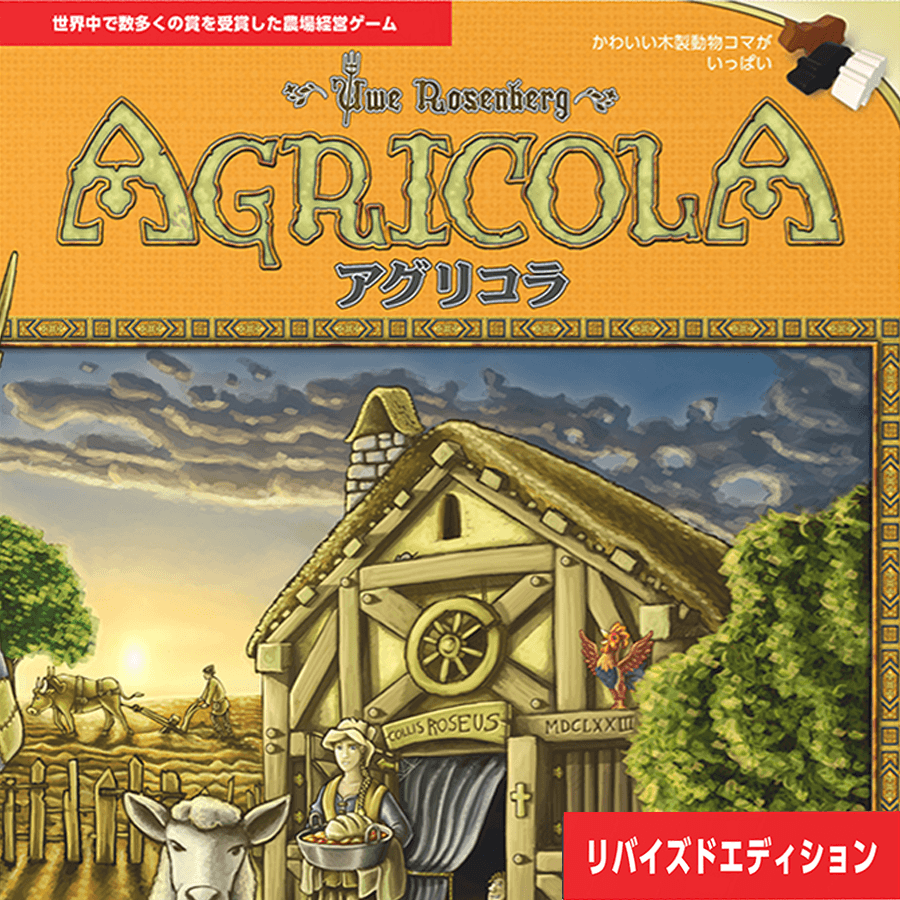
アグリコラ:リバイズドエディション | ANALOG GAME INDEX
世界中で熱狂的ファンを増やし続けている『アグリコラ』。9年目の改定新版登場。
hobbyjapan.gamesComparison Table: All 10 Games
Here the 10 games are laid out side by side with session timing tags so you can work backward from your schedule. Beyond what individual reviews cover about why each game is fun, the comparison table is designed to show when it's realistic to bring each game out, what player count makes it sing, and how heavy the first-session rules explanation is. Knowing at a glance whether something fits a weeknight or a weekend goes a long way toward narrowing the list.
Full Comparison
| Title | Timing Tag | Players | Time | Age | Difficulty | BGG Weight (reference) | Mechanics | Competitive/Coop | Best Count | Reference Price (notes) | First-Session Explanation |
|---|---|---|---|---|---|---|---|---|---|---|---|
| Terraforming Mars | Weekend 2-hour | 1–5 | 90–120 min | 12+ | Intermediate | — | Engine building, card drafting, tile placement | Competitive | ~3 players | — | Medium |
| Power Grid: Recharged | Weekend 2-hour | 2–6 | 120 min | 12+ | Intermediate | — | Auction, resource market, network building, income management | Competitive | 4–5 | — | Medium |
| Istanbul Big Box | Weeknight 60–90 min | 2–5 | 40–80 min | 10+ | Beginner–Intermediate | — | Hand management, route optimization, set collection | Competitive | 3–4 | — | Low |
| Blood Rage | Weeknight 60–90 min | 2–4 | 60–90 min | 14+ | Intermediate | — | Area control, card drafting, combat, special ability management | Competitive | 4 | — | Medium |
| Concordia | Weeknight ~90 min | 2–5 | 90 min | 12+ | Intermediate | — | Hand management, route building, engine building, scoring optimization | Competitive | 3 | — | Medium |
| Scythe | Weeknight 90 min / Weekend deep dive | 1–5 | 90–115 min | 14+ | Intermediate–Advanced | — | Engine building, area control, resource management, action selection | Competitive | 3–4 | — | High |
| Brass: Birmingham | Weekend 2-hour | 2–4 | 60–120 min | 14+ | Advanced | — | Economic, network building, hand management, resource chaining | Competitive | ~3 players | — | High |
| Ark Nova | Weekend half-day | 1–4 | 90–150 min | 14+ | Intermediate–Advanced | — | Card management, action intensity cycling, tile placement, set collection | Competitive | 2–3 | Japanese edition list price available | High |
| Great Western Trail 2nd Edition | Weekend 2-hour | 1–4 | 75–150 min | 12+ | Intermediate–Advanced | — | Deck building, circuit optimization, building placement, resource management | Competitive | 2–3 | — | Medium |
| Agricola Revised Edition | Weekend deep dive | 1–4 | 30–120 min | 12+ | Intermediate–Advanced | — | Worker placement, resource management, farm building, card management | Competitive | 3–4 | — | High |
ℹ️ Note
Looking across the table, Istanbul Big Box and Terraforming Mars are the most accessible entry points. Istanbul is short and what you explain translates directly into what you do on your turn — it's a natural bridge for players coming from medium-weight games. Terraforming Mars runs longer, but the "terraform Mars" objective is concrete, and even as the cards get complex, "grow plants" and "raise temperature" stay as intuitive action anchors.
At the other end, Brass: Birmingham, Ark Nova, and Agricola are the ones to reach for when you want high-density strategic play from the start. All three are excellent, but they're best approached by players who arrive at the table already in the mindset of "this is what we're doing today." Ark Nova especially — on top of its listed play time, the initial orientation period is real, and our editorial team consistently experiences it as a weekend centerpiece, not a weeknight game.
For player count: if you can reliably get 4–5 people together, Power Grid: Recharged and Blood Rage are the games that benefit most from that. Power Grid's auction and resource market sharpen noticeably with more players; Blood Rage's board pressure and draft reading come into focus. Conversely, for groups of 2–3 playing focused, low-Downtime sessions, Concordia, Ark Nova, and Great Western Trail 2nd Edition are the stable choices — you stay invested in your own development arc while Downtime stays reasonable.
💡 Tip
When reading the comparison table, start by filtering to 3 games using the timing tag, then cross-reference best player count and first-session explanation difficulty. Optimizing for pure quality of game is less effective than asking "can we actually run this tonight?" — that question keeps satisfaction high with heavy games.
The BGG Weight column is included as a relative indicator of complexity feel, not a definitive ranking. Same range scores can feel very different — Terraforming Mars at its weight tier is propelled forward by card excitement; Power Grid at a similar tier makes you work through market pressure and turn-order tension. The numbers are close; the weight quality is different.
Note: timing tags are based on listed play times adjusted for first-session explanation and verification overhead. Games like Scythe and GWT 2nd Edition that experienced players can push into weeknight territory are still tagged for a longer first-session window, because that's what the first play actually takes.
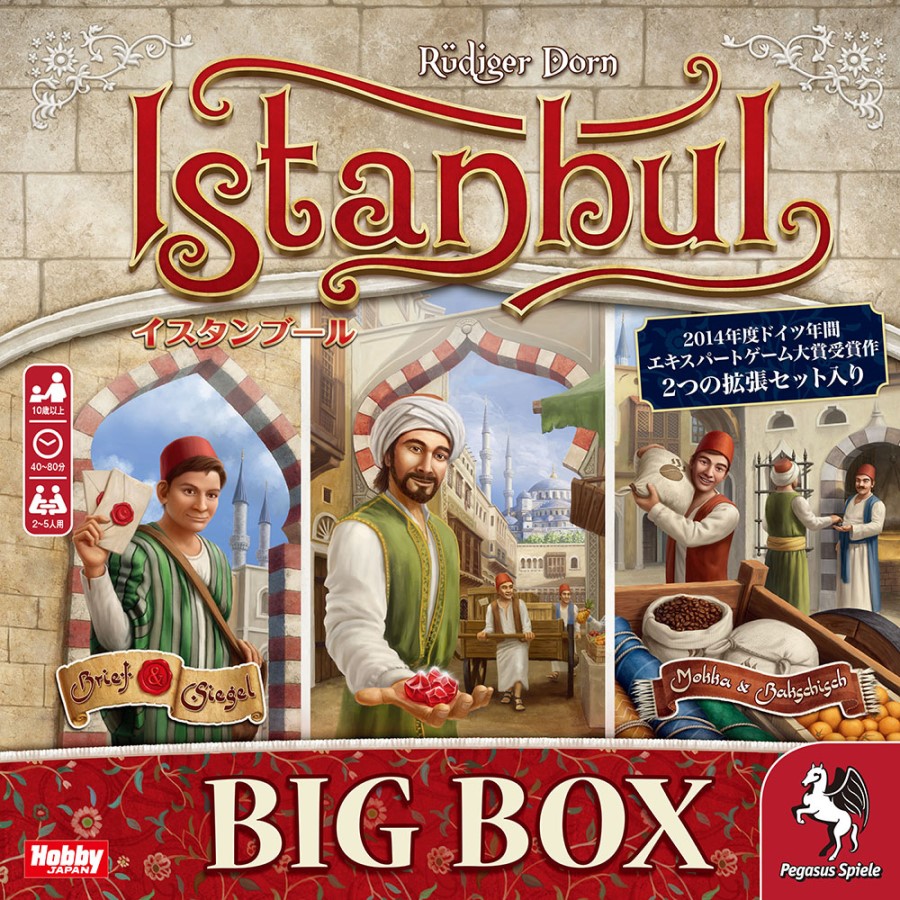
イスタンブール BIG BOX | ANALOG GAME INDEX
あの名作『イスタンブール』に拡張2つを同梱したデラックス版!BIG BOXだけの選択ルールも!!
hobbyjapan.gamesRecommendations by Setup: 2-Player, 3–4 Players, Long Session Welcome
Sorted by player count, the options sort themselves out quickly. For 2-player groups, the games with the sharpest read-your-opponent depth are Ark Nova and Concordia. Neither lets Downtime creep up, and both reward the particular pleasure of comparing your development arc against one opponent's. The key risk in 2-player heavy games is landing either at "the board's too big and we don't interact" or "this is suffocatingly cramped" — both of these games sit comfortably in between. Ark Nova tends to run long in 2-player: you start thinking "90 minutes" and end up past 120 because "one more decision" keeps being worth it. Concordia, by contrast, has enough cognitive weight to be satisfying but a clean enough turn structure that it's reliable on not ballooning past its listed time — a meaningful advantage on a weeknight.
For 3–4 player groups, the strong pillars are Terraforming Mars, Power Grid: Recharged, Scythe, and Blood Rage. Terraforming Mars brings corporation asymmetry and card interaction into productive competition at that count. Power Grid's market and turn-order tension jumps sharply with more people. Scythe's map standoffs emerge naturally, and Blood Rage's draft and area pressure both read clearly. All four are fine at lower counts, but the quality jump when you hit 3–4 is where "the game becomes itself."
For up to 5 or 6 players, Power Grid: Recharged is the practical standout — it supports up to 6 players, and it stays on the shortlist for game nights where attendance is uncertain. Heavy games often fall off the list based on player count alone, but this title absorbs a full table without losing its character. If you have 5 people and want everyone genuinely thinking in an economic game, it's a reliable anchor.
Under 90 Minutes
For a realistic weeknight, Istanbul Big Box and Blood Rage are the first candidates. Istanbul's turns have a legible purpose, the game doesn't stall, and it bridges medium-weight and heavy-weight experience cleanly. Blood Rage has strong competitive energy, but the round structure is clear and the game maintains tempo through the final turn. Both are practical under-90-minute choices — the right pick for a night where "I want something that feels like a real game" is the goal.
Games that genuinely need a 2-hour block are Brass: Birmingham, Power Grid: Recharged, Ark Nova, and Concordia. Brass and Power Grid are built around market reading — the thinking time is the value, not overhead. Ark Nova's card-checking and optimization density mean 2-player sessions regularly exceed estimates. Concordia is lighter-feeling than its reputation suggests, but tables that take scoring seriously will use the time. Trying to fit these into 90 minutes creates more friction than scheduling a proper session does.
💡 Tip
If 2-player time management matters: Ark Nova tends to pull toward 120+ minutes because "one more consideration" keeps feeling worthwhile. Concordia and Istanbul Big Box have cleaner end-of-game signals and are less likely to push past their listed times — a practical edge for weeknight gaming.
Cooperative vs. Competitive
Every game highlighted in this guide is fundamentally competitive. Some use direct action interference; others use market pressure and positional racing — but the core interest in all of them is the combination of "optimize my own path" and "factor in how opponents are growing." The 2-player picks (Ark Nova, Concordia) sharpen the reading element; the 3–4 player picks (Power Grid, Blood Rage, Scythe) emphasize the richness of interaction.
If cooperative heavy games are what you're after, the selection criteria shift substantially. Cooperative games prize ease of deliberation, satisfying role differentiation, and well-designed failure recovery loops — not the hand efficiency and disruption tolerance that matter in competitive games. In that context, games like Spirit Island become strong candidates. This guide focuses on competitive titles, so cooperative games aren't covered in depth here — but the distinction matters. "I want to play a heavy game" can mean "I want to beat opponents" or "I want to solve a hard problem with teammates," and those lead to very different shelves.
Play Ark Nova online from your browser
Play Ark Nova online from your browser with the whole world!
en.boardgamearena.comWhat to Know Before You Commit to a Heavy Game
Heavy games aren't a genre where "this is acclaimed, so it's a safe buy." High quality doesn't automatically mean a good fit — if the money, time, and player count aren't already in place, the evaluation can go wrong fast. Prices run higher than medium-weight games; the practical mid-range is roughly 7,000–15,000 yen (~$46–98 USD). Scythe is listed around 11,550–12,100 yen (~$75–80 USD) on Arclight's page; Brass: Birmingham around 9,020 yen (~$59 USD); Ark Nova's Japanese list price around 9,900 yen (~$65 USD). Add expansions and the total climbs further. Our editorial team's consistent experience: play the base game at least three times before deciding whether to buy expansions. Adding content before you know whether the core resonates just increases information density without improving the experience.
Setup and teardown overhead is another underappreciated barrier. With card-heavy games, sorting before the game can drain your enthusiasm for actually playing it. Games like Terraforming Mars and Ark Nova, which have large card pools and multiple decks to manage, are especially prone to eating 10+ minutes between opening the box and having an actual table state when you're not organized. A 200-card title with a collapsed insert can burn 10 minutes before the first token is placed. If you plan to play regularly, investing in proper storage — not just zip-lock bags, but an insert that separates tokens from cards — has a meaningful effect on how often the game actually gets played. Setup is part of the game experience in heavy games, not a preamble to it.
Finding consistent players is also harder than it looks. The practical sweet spot is 2–4 players — games that fit this range have more scheduling flexibility. Brass: Birmingham handles 2–4; GWT 2nd Edition and Ark Nova go 1–4; all of these adapt well to groups where attendance varies. Long-session titles need more than just enough players — they need shared expectations about start and end times. Committing to a game with a vague "we'll see how it goes" end-time agreement tends to end in fatigue rather than satisfaction. In heavy game sessions, agreeing on the time window in advance matters as much as choosing the game.
One more real challenge: some games don't reveal their quality on first play. Some heavy games spend game one on rules orientation and only open up on the second or third session. Agricola and Brass: Birmingham are both like this — the scoring logic and positional reading emerge through play, not through explanation. Putting games like these in front of new players as a "let's see if you like it" session tends to produce "that was hard" rather than "let's play again." Our approach: treat these as dedicated learning sessions — one circuit through the game focused on understanding the flow rather than winning. That single session changes the second game completely.
Knowing when to add expansions is another decision worth being deliberate about. As noted above, adding new rules before the base game is stable just adds processing overhead. The value of starting small, playing more, and expanding incrementally is consistently demonstrated across heavy game communities and introductory guides alike. When our editorial team added early Terraforming Mars expansions before the base game had settled, the additional card evaluation axes slowed everyone's decision-making and dragged the session. Returning to base-only immediately clarified what the game was actually about and the session improved. New rules, one at a time, only after the base runs smoothly.
Side Column: The Extreme End of Heavy Games
Developing a taste for heavy games naturally makes you curious about what lies at the far extreme — but that territory is genuinely different from "a somewhat heavy next game." Gloomhaven has 100+ scenarios, 200+ total hours of play, and weighs 9.5 kg. This isn't a game you pull from the shelf on a whim — it's an ongoing project you maintain. The satisfaction comes not just from individual sessions but from keeping records, playing with the same group over time, and managing the physical state of the box. Owning it is exciting, but the payoff comes from sustaining it, not from having it.
Even further out, Mega Civilization runs up to 18 players, approximately 12 hours, weighs over 11 kg, requires a 2+ meter playing surface, and takes an hour just to explain the rules. At this point, the game's quality is almost secondary — securing a venue, recruiting the right number of players, and scheduling food breaks are the primary logistics challenge. Knowing that ultra-heavy games exist is useful primarily because it clarifies that the "somewhat heavy game I'm considering" and "a multi-day community event" are on completely different axes of required resources.
【エラッタ】グルームヘイヴン - ArclightGames Official
最新のエラッタをまとめたページを公開いたしました。 Gloomhavenエラッタまとめページ 【最終更新】20
arclightgames.jpAvailability and Reprint Cycles
Heavy games have waves of availability — and this affects your choices in practice. A title that's easy to find in stores for several months can go out of stock quickly and stay that way. The reverse is also true: immediately after a reprint, options open up and prices stabilize. Even games with established domestic distribution like Scythe and Brass: Birmingham have periods where timing and stock don't align.
Understanding this cycle changes how you read prices. A game listed at a reasonable price on a publisher page can look very different in the market before versus after a reprint run. Pre-reprint shortages inflate perceived prices; post-reprint, "this seems reasonable for what it is" becomes the natural response. Since heavy games aren't cheap by category, shopping during stable distribution windows makes comparison easier.
💡 Tip
When searching for Japanese editions, tracking new release and reprint schedules rather than just looking up a title gives you a clearer sense of whether you're in a waiting period or a buying window. Pages that actively track upcoming stock — like those maintained by hobby game news sites — help you read the room: "is this a wait-and-see moment, or has supply returned?"
Our editorial team treats "is this right after a reprint?" as a real factor in heavy game purchases. For perennial candidates like Ark Nova and Great Western Trail 2nd Edition, resisting the urge to buy in a shortage and waiting for distribution to normalize also means more comparison options are in stock at the same time — which produces better decisions overall.
Heavy games earn their value through repeated play, not from being on your shelf. Understanding availability cycles is less a cost-saving trick and more a way of improving the quality of your selection — because you're choosing from a full field, not whatever happens to be in stock.
【エラッタ】サイズ – 大鎌戦役 – 完全日本語版 - ArclightGames Official
●箱裏(2018.8.17追加)誤:コイン 80枚正:コイン 88枚 ●ルール説明書p.2「1.内容物」(20
arclightgames.jpSide Column: The Extreme End of Heavy Games
If Gloomhaven is on your radar, the sheer scale deserves its own moment. 100+ scenarios, 200+ total play hours, 9.5 kg — this isn't really an extension of the heavy game category. It's closer to a long-term commitment you maintain as a group. What determines satisfaction isn't any single session, but whether you can keep records, bring the same people back, and manage the box's physical state over many months. The joy of owning it is real, but it comes from sustained operation, not from acquisition.
Mega Civilization
The furthest outlier in any discussion of heavy games: up to 18 players, approximately 12 hours, over 11 kg, a 2+ meter playing surface, and an hour's worth of rules explanation before you start. At this scale, "complex game" isn't quite the right frame. The logistics of running the event — player coordination, venue, food and breaks built into the schedule — dwarf the game's internal complexity. Standard heavy game sessions work with 3–4 regular players; Mega Civilization's player count requirement alone puts it in a different category.
What's interesting is that at this scale, "complex equals heavy" stops being sufficient. The volume of processing and negotiation is real, but the cost of staging the event is the real weight. Regular heavy games work in home settings; Mega Civilization requires selecting the right table. It's less the apex of heavy game design and more a monument to how far the board game format can extend before it becomes something else entirely.
For a grounded look at the scale involved — Gloomhaven's total play time and weight in particular — game media covering ultra-heavy titles gives useful concrete context. The numbers for Mega Civilization (18 players, 12 hours, 11 kg+, 2-meter+ surface) seem like exaggeration until you see them laid out side by side. That context makes clear that ultra-heavy games aren't "somewhat heavier acclaimed titles" — they're productions whose organizing is the project.
For purchase and operation principles around long-campaign and ultra-heavy games, first-purchase guides for board games cover the foundational thinking.
If the long campaign format of Gloomheavens appeals — the weight goes in a different direction, but the ongoing-play-accumulates-experience appeal is similar — legacy games as a category are worth looking at alongside standard heavy games. If your excitement comes from experience building over time rather than pure session density, that preference points toward a different shelf from standard competitive heavy games. Ultra-heavy games aren't for everyone, but they clarify that "I love heavy games" can mean "I love dense strategic thinking" or "I love the investment of something I return to over many months" — and those are different tastes.

About - Mega Empires | Board Game | Official Site
mega-empires.comAvailability and Reprint Cycles
Japanese-language editions of heavy games are especially sensitive to stock waves, separate from their actual quality. A title that's easy to find in stores and online during one period can become genuinely scarce within months. After a reprint arrives, availability improves and pricing stabilizes. Even games with relatively strong domestic distribution like Scythe and Brass: Birmingham can have periods where what you want and when it's available don't overlap.
Understanding this wave behavior changes how you read prices. A game with a published price on a distribution page can feel expensive or reasonable depending entirely on whether you're shopping before or after a reprint. Pre-reprint scarcity inflates market perception; post-reprint, the same game reads as a sensible purchase. Heavy games don't come cheap as a category, so shopping in stable-distribution windows improves comparison accuracy.
💡 Tip
When hunting for Japanese editions, tracking upcoming release and reprint calendars alongside the title itself gives you a clearer read on whether you're in a waiting period or a buying window. Sites that actively monitor hobby game release schedules can tell you "is stock back now, or is this still a pre-reprint drought?" — that context is practically useful.
Our editorial team factors "is this right after a reprint?" into heavy game purchase decisions. For perennial picks like Ark Nova and GWT 2nd Edition, waiting for distribution to normalize instead of grabbing during a shortage also means comparable titles are in stock at the same time — which produces better decisions than scarcity-driven choice.
Heavy games earn their value through repeated play. Availability awareness isn't about saving money — it's about improving selection quality by choosing from a full field rather than whatever's currently in stock.
Conclusion: How to Pick Your First Heavy Game
When in doubt, narrow by usual player count first, then acceptable play time, then preferred mechanics. Our editorial team's shorthand: for 2-player groups, Ark Nova or Concordia; for 3–4 player groups at the 90-minute range, Blood Rage or Istanbul Big Box; for committed 2-hour sessions, Power Grid: Recharged, Brass: Birmingham, or Terraforming Mars. Within those filtered candidates, pick the one where the first-session core concepts are clearest — that's the lowest-risk choice.
For anyone who wants to build up from the fundamentals, pairing this guide with a board game first-purchase guide or a beginner's overview of board game selection gives you useful cross-reference material for the decision.
Related Articles
Scythe Review | The True Power of Economic Management
Scythe may look like a combat game due to its imposing mechs, but the real heart of competition lies in resource management, engine building, and board control—making it one of the finest economic racing games in tabletop gaming.
Best 2-Player Strategy Board Games | Compared by 30-Minute, 60-Minute, and Heavy Weight
If you're hunting for a 2-player strategy game that actually makes you think, the real question isn't which title is most popular — it's how long you want the fight to last. Battle Line delivers sharp reads in 30 minutes, 7 Wonders Duel wraps up a satisfying weeknight session in about 40, and Twilight Struggle is the kind of game you clear your weekend calendar for.