
Best Board Games for Kids | How to Choose by Age
Best Board Games for Kids | How to Choose by Age
Picking a kids' board game based on age rating alone is a surprisingly easy way to miss the mark. The real key is checking five factors — age, player count, playtime, rule complexity, and safety — which dramatically cuts down on games that never make it to the table.
Relying on the age rating alone when buying a board game for kids is a surprisingly reliable way to end up with something that sits on the shelf. What actually works is checking age × player count × playtime × rule weight × safety — five factors that drastically reduce the "we bought it and never played it" problem.
This article gives you specific recommendations for the 4–5, 6–7, and 8–10 age ranges, covering "first game ever," "parent and child duo," and "family of three or four." I spent years as a childcare worker before becoming a board game café staff member, and the picks here are the ones I've genuinely recommended for bedtime 15-minute sessions, rainy afternoon parent-child time, and family gatherings — time and again.
I'll touch on educational benefits too, but I'm keeping expectations grounded: I'll cite research and real classroom examples rather than overselling it. The main goal is getting you to a confident choice — one that fits this child, this group size, and this time slot — without the second-guessing.
Don't Pick Kids' Board Games on Age Alone
What I want to look at here is a six-factor view that starts with the age label but extends to player count, playtime, rule complexity, safety, and theme interest. Review sites like Bic Camera and mybest already stress checking player count and playtime alongside age — and that reflects a real pattern. The same game can feel completely different depending on how long a child can stay focused, or how many people are at the table.
Age recommendations are a rough guide. Some kids slide right into Dobble or Corridor — technically rated for older players — with a little parental support. Others hit the listed age and still struggle, depending on how tired they are that day or how sensitive they are to losing. It's more useful to treat the age label as the point where a child can probably process the rules on their own, rather than a pass/fail line.
Choosing by Playtime Reduces Mistakes More Than Choosing by Age
The single factor I find most predictive of success isn't actually age — it's playtime. Match a game to your household's daily rhythm and the fit becomes easy to read.
The 5–15 minute tier works before or after meals, even right before bed. Gemstone runs about 5 minutes, Nandja Monja about 15, and both Dobble and Nine Tiles land around 15 minutes too — all short enough that losing leads straight to "one more round" rather than hurt feelings. Quick games let the next round absorb the sting of defeat.
The 15–30 minute tier suits days when you actually set aside proper play time. Quoridor runs 15–25 minutes, Splendor about 30. A bit more thinking, more satisfaction — this range starts clicking for kids around ages 6–7.
Anything 45 minutes or longer brings a lot more depth, but it can feel heavy on weekday evenings or after dinner. Catan runs roughly 60–120 minutes; Game of Life is about an hour; Monopoly variants can hit 45 minutes or more. One night I put out a 45-minute game with a 6-year-old and halfway through the frustration and tiredness combined into tears. The next day we played three rounds of a 5-minute game and she was laughing, saying "I'll win next time." Same child, completely different experience — the rhythm of wins and losses matters as much as the length.
宝石がいっぱい! - ArclightGames Official
ご購入はコチラから! 1ゲーム5分のハイテンポ宝石発掘ゲーム! プレイ人数:2~6人 プレイ時間:5分 対象年
arclightgames.jpRule Complexity: "How Many Rules to Hold in Your Head," Not "Can They Read"
The best way to gauge rule weight is not the length of the rulebook — it's how many things a player has to keep in mind at once. At ages 4–5, games shine when there's essentially one thing to do per turn. Something like Gemstone — where each action is a single simple move — or Nandja Monja — where you name a creature and then call that name out when it reappears — has an extremely low barrier to entry.
Around age 6, games like Dobble's visual-speed mechanics or Quoridor's light forward-thinking become accessible. By 8, candidates include the placement planning of Blokus, the negotiation of Catan, and the sequential optimization of Splendor. The reason age-based recommendations shift so cleanly at 4–5, 6–7, and 8+ is largely because those are the real thresholds in cognitive load.
Player Count: "Fun Number" vs. "Supported Number"
The range printed on the box and the number at which a game really sings are not always the same. Quoridor supports 2–4 players but works beautifully as a parent-child two-player game, where the mind-reading comes through clearly. Dobble goes up to 8, which makes it flexible for siblings or extended family. Catan is designed for 3–4, so if your household is mostly a duo, it won't see much table time. Whether your family's default is two people or three to four changes which games actually get played.

Play Quoridor online from your browser
Play Quoridor online from your browser with the whole world!
en.boardgamearena.comSafety Is a Separate Axis from the Age Label
Safety deserves its own look, separate from the recommended age. The trick is looking at the age rating and the small parts separately. Game of Life has figurine pegs, Gemstone has gem tokens, and Catan and Blokus both have many pieces. If swallowing hazards are a concern, card-heavy games like Dobble — which plays entirely with cards — are easier to feel comfortable with. Japanese toy safety standards (ST mark) treat small parts as a distinct priority point for good reason.
💡 Tip
When in doubt, ask "Can we finish this in 15 minutes on a weekday evening?" and "Will there be tiny parts scattered all over the table?" before asking "Is this too hard for them?" That order of questions leads to better choices.
Theme interest also has a bigger impact than people expect. Whether a child gravitates toward gems, bugs, animals, ghosts, mazes, or pretend money can change how long they stay engaged with a game of identical difficulty. A gem-and-digging theme like Gemstone is an easy sell to some kids. A build-walls-and-find-escape-routes game like Quoridor clicks immediately with others. If the theme doesn't connect, engagement tends to drop before the rules are even learned.
Looking at all six factors together, you shift from "she's 6 so let's get this" to "she's 6, it's just the two of us, we have 15 minutes before bed, let's keep the pieces simple, fast wins are good, and she loves animals or gems." That framing cuts first-purchase regrets significantly.
人生ゲーム|商品情報|人生ゲーム|タカラトミー
www.takaratomy.co.jpChoosing by Age Range | 4–5, 6–7, and 8–10
Ages 4–5: Memory, Reflexes, Color & Shape Recognition / 5–10 Minutes
At 4–5, what works best is the spot-it, remember-it, match-it type. Age-specific roundups consistently recommend games where the entry point is instant recognition rather than a long explanation — and the real-world results back that up. A game that delivers "I found it!" or "I remembered!" in the first few seconds outperforms one that requires building toward a payoff.
The games that click for this age have short rounds and turns that make immediate sense. Gemstone is rated 4+, plays 2–6 people, and runs about 5 minutes — the action each turn is so simple it's an ideal first game. Nandja Monja is also 4+, 2–6 players, about 15 minutes, and the rhythm of flipping a card and calling out a name keeps things moving fast enough that even young kids rarely feel like they're waiting around. The 60-card / 15-minute design means each card is its own little event — concentration holds up well.
What I've found through experience is that the magic at 4–5 is games where luck and reflex let kids beat adults for real. The priority isn't making children think deeply — it's making them feel like genuine participants in the competition. Color and shape matching, memory, and quick-response mechanics create natural parity without adults having to hold back. And when a round ends in 5–10 minutes, the losing child can reset and try again almost immediately.
Ages 6–7: Light Strategy and Deduction / 15–20 Minutes
At 6–7, something shifts: on top of fast reaction games, kids start enjoying the pleasure of thinking one step ahead. This is when age-specific lists start including games with light strategy or deduction elements. The thinking time itself becomes fun — "what happens if I place here?" or "what is my opponent about to do?"
Quoridor and Nine Tiles show this well. Quoridor is 6+, 2–4 players, 15–25 minutes, and every turn presents the same two-way dilemma: move forward, or place a fence to block your opponent. In a two-player game each person holds 10 fences, so burning through them early leaves you exposed later — a feeling that emerges naturally from play. The rules are remarkably short, yet every decision matters. Grab that strategic texture at ages 6–7 and a child's board game world opens up considerably.
Dobble (6+, 2–8 players, ~15 minutes) looks like pure reflex but actually rewards a skill that develops with age: knowing where to look first. Nine Tiles (6+, 2–4 players, ~15 minutes) taps into the satisfaction of arranging and flipping tiles to match a target — the processing speed needed fits this age group perfectly. All three run 15–20 minutes and deliver the feeling of "my choices led to this outcome" within a single session.
In my own experience, what suddenly gets exciting around age 7 is the rush of blocking an opponent's intended move. In Quoridor, the moment you place a fence and your opponent goes "I was heading that way!" — and everyone laughs — that exchange signals the shift from pure reflex play into anticipation and counter-play.
Ages 8–10: Forward-Thinking, Negotiation, and Mind-Reading / Up to 20–45 Minutes
By 8–10, judgment, planning ahead, and reading opponents take real shape. This is when children start thinking not just "what's good for me" but "what can I do to stop them" or "I'll concede this now and get it back later." Review roundups for this age group consistently shift toward strategy games that hold up alongside adults.
Blokus (7+, 2–4 players, ~15–20 minutes) is a natural entry point — the goal of crowding out opponents while keeping room to expand is intuitive. On days with more time, Catan enters the picture. The Japanese edition (Catan Standard) is 8+, 3–4 players, ~60–120 minutes — longer than the main range of this section, but around age 8 the multi-layered decisions of gathering resources, trading, and choosing where to develop start clicking for the right kids. For something shorter, Splendor (10+, 2–4 players, ~30 minutes) fits beautifully for kids who enjoy sequence optimization.
The defining shift in this age group is that negotiation and maneuvering become part of the fun themselves. Around age 8, "I'll give you this if you let me through next turn" stops being a plea and starts being gameplay. I've seen it happen plenty of times: a child discovers the joy of blocking at 7, then at 8 gets suddenly hooked on the art of talking their way to an advantage. At that point, a 20–45 minute game stops feeling long and starts feeling like "enough time to actually think."
ℹ️ Note
More games become viable as children get older, but the real hit is finding the length at which a particular child can think comfortably — not the hardest game they can technically handle. Within the 8–10 range, a child who loves reading opponents will dive deep into Blokus; a child who loves negotiation will take off with Catan-style games.

ブロックス | Mattel Games マテル ゲーム | Mattel マテル
ボードのマスに各色21個の形の異なるピースを交互に置いていく陣取りゲーム。2~4人で遊ぶことができるので、家族みんなで楽しめます。プレイ時間は15分~20分程度なので、短い時間でも遊ぶことができます。最後に一番多くピースを置いた人が勝者とな
mattel.co.jpRecommended Games by Age
Ages 4–5: What Works and Why
The games that land hardest at 4–5 are the ones that return "I got it," "I did it," and "again!" fast. Clear one-action-per-turn games move easier through a session than anything requiring extended thought. For households just starting out with two to four players, games that end in 5–15 minutes are the most manageable — 5-minute games genuinely deliver instant "again!" The format works well squeezed into a gap in the afternoon, or as one quick game before bed.
Whether kids can realistically compete with adults is also worth watching at this age. Reaction speed, memory, and pattern recognition create real parity — kids feel like they're competing, not just participating. Games that require forward planning or have long turns break that feeling quickly.
Here's a summary table of candidates across all age ranges for easy comparison:
| Age Range | Game | Players | Time | Rule Weight | Safety Notes |
|---|---|---|---|---|---|
| 4–5 | Nandja Monja | 2–6 | ~15 min | Very light | Card-based, easy to handle |
| 4–5 | Gemstone | 2–6 | ~5 min | Very light | Has gem tokens |
| 6–7 | Quoridor | 2–4 | 15–25 min | Light strategy | Wooden components |
| 6–7 | Ubongo (official age 8+; parental support recommended for 6–7) | 2–4 | Not listed | Light strategy | Puzzle pieces and gems |
| 6–7 | Nine Tiles | 2–4 | ~15 min | Light | Tile-based |
| 8–10 | Catan Standard | 3–4 | ~60–120 min | Gateway medium | Small pieces and cards |
| 8–10 | Splendor | 2–4 | ~30 min | Light-medium | Gem tokens |
| 8–10 | Blokus | 2–4 | ~15–20 min | Light strategy | Plastic pieces |
Nandja Monja: Ages 4+ — Reflex and Memory That Put Kids on Equal Footing
2–6 players, ~15 minutes, ages 4+. The characters have wildly expressive faces — each player names one on the spot, and whoever calls the name first when it reappears wins the card. The entire game fits in one sentence, which makes it one of the best first games for ages 4–5.
It suits families where a parent-child pair, a group of siblings, or a noisy gathering with grandparents all feel like fair game. The 2–6 range means unpredictable headcounts aren't a problem. Sixty cards in about 15 minutes keeps a steady pace — each card is its own moment, so even young players rarely feel stuck waiting. Adults playing seriously lose to good-name-callers all the time.
The game isn't the best fit for families who prefer calm, deliberate puzzles. Names fly the instant a card appears — it's not a quiet experience. And the joy depends heavily on the naming mechanic, so children who aren't into wordplay may find less to grab onto.
Safety-wise, the card-only format is easy to manage. The absence of scattered small parts is part of what makes it a low-stress first game.
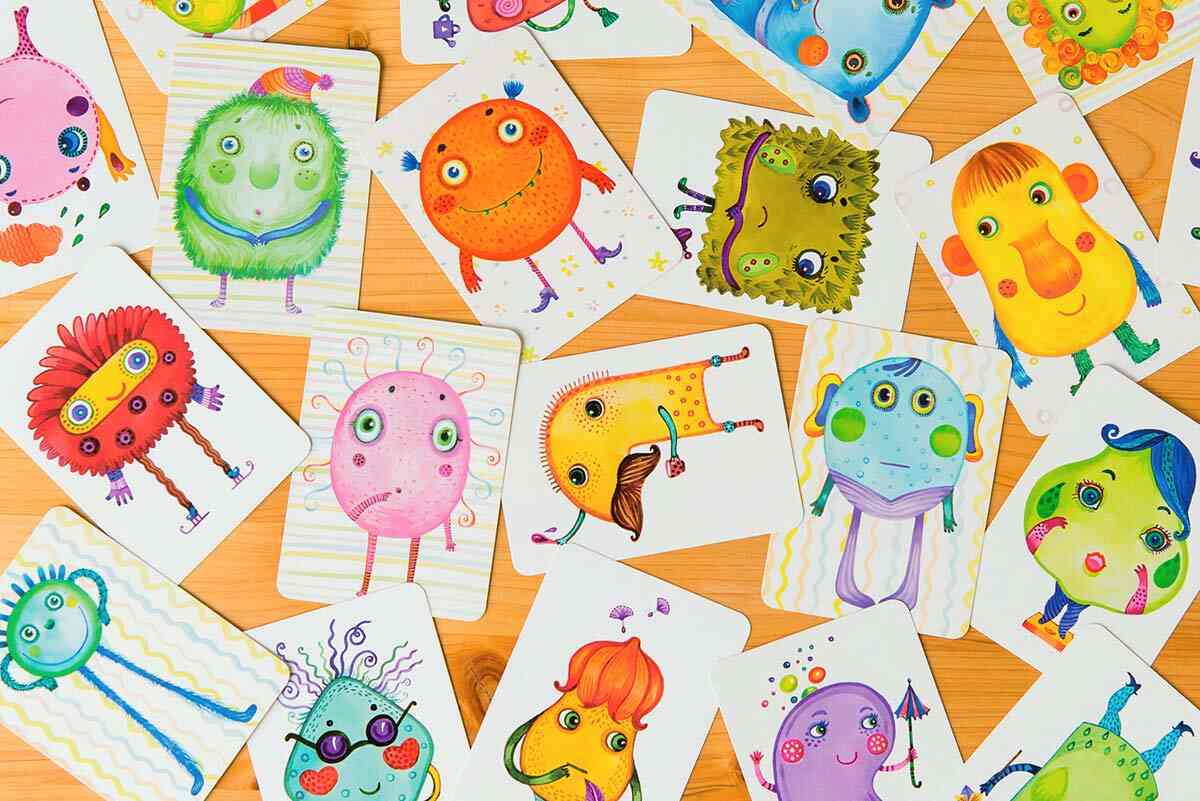
ナンジャモンジャ・シロ&ミドリ | すごろくやのボードゲーム
すごろくやのボードゲーム『ナンジャモンジャ・シロ&ミドリ』の紹介
sugorokuya.jpGemstone: 2–6 Players / 5 Minutes / Ages 4+ — Big Payoff in Almost No Time
2–6 players, ~5 minutes, ages 4+. This might be the shortest game in this whole roundup. A single turn is easy to follow, and rounds end before anyone loses interest — which means every first session ends with a sense of accomplishment.
It works well for families with kids who have trouble sustaining focus, and for households that want to keep the barrier to starting a game as low as possible. Five-minute games have a built-in reset: win or lose, the weight doesn't linger, and "let's go again" comes naturally. This is one I personally reach for at the start of a game session, or to fill the few minutes before dinner.
It's less suited to families looking for deep, satisfying thinking each round. The appeal is tempo and accessibility — think of it as a game that gets better the more times you play it in a session, not the longer each session runs.
The Arclight Games official product page lists it at ¥3,300 tax-included (~$22 USD) (as of 2026-03-14).
Dobble (2023 Edition): 2–8 Players / 15 Minutes / Ages 6+ — Speed Pattern Matching (Parental Support Suggested Under 6)
2–8 players, ~15 minutes, ages 6+. Any two cards always share exactly one matching symbol — find it before anyone else does. The rules are simple, but real skill gaps in visual speed do show up.
If you're considering it for 4–5-year-olds, the best setup is a 5-year-old who's naturally good at spotting shapes, with a parent helping keep things moving. The 2–8 player range makes it easy to adapt to larger family gatherings or when friends come over. Fifteen minutes keeps it self-contained even in a busy evening.
It's a strong fit for families who want an energetic, everyone-reacts-at-once game and households with varying group sizes. Less suited to families where the child prefers to look carefully and take their time — the speed-based format rewards a different mode of engagement.
Engames Shop lists the 2023 edition at ¥2,200 tax-included (~$15 USD) (as of 2026-03-14).
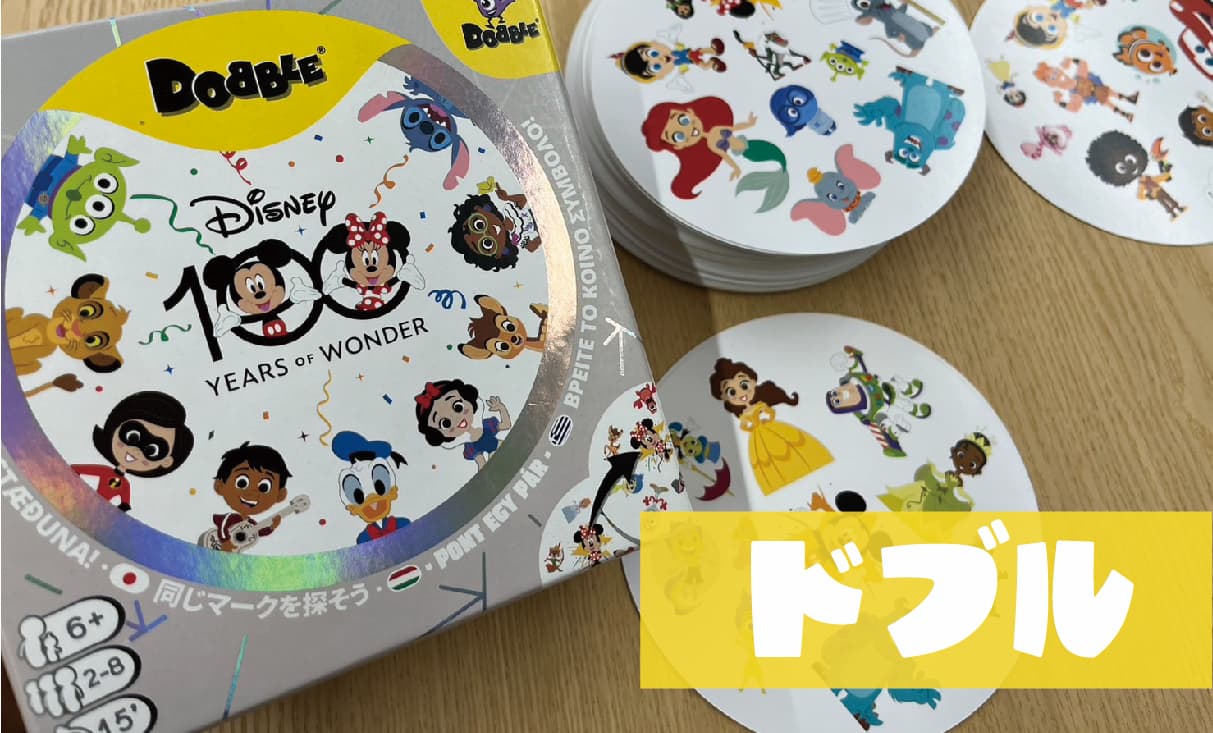
【1分で分かる図解解説】「ドブル」のルールと遊び方を解説!|ボドゲバディ
本記事では、「ドブル」について解説していきます!!ちびっこに根強い人気を誇る、シリーズ累計500万個以上も売れている大人
boardgame-comunity.comAges 6–7: What Works and Why
At 6–7, games start being more interesting when they offer "what do I do next?" alongside "who found it first?" What works here is short rules that still make every decision feel meaningful. The sweet spot for time is 15–30 minutes — too short and there's not enough substance, too long and focus breaks. Right in the middle is where the wins happen.
What makes this age range interesting is that kids start to understand why they won or lost. "I placed there and that's why I won." "That one move cut off my path." Games where that cause and effect is visible create momentum for the next session. Moving from pure reflex to games where your hands and your thinking work together is the smoother transition than jumping straight to heavy strategy.
💡 Tip
At 6–7, rule comprehension is improving but children are still sensitive to waiting. That's exactly why games where each turn resolves quickly and the whole thing wraps up in around 15 minutes tend to get played again and again.
Quoridor: 2–4 Players — An Intense Two-Player Strategy Gateway
2–4 players, 15–25 minutes, ages 6+. Each turn, you either move your pawn forward or place a fence to slow down your opponent. Those two options — that's the whole game, and it's remarkably agonizing. In a two-player game, each player holds 10 fences, so spending them too early puts you in a tough spot by the endgame — a dynamic that players figure out through play rather than instruction.
It works best for parent-child pairs who want a real competition, and households ready to step up from luck-based games. It's an excellent gateway to reading your opponent's intentions, and two players works great — you could argue the two-player game is the most compelling, since every move is directly legible.
Less suited to families who want a lot of laughs and dramatic moments. The game builds tension, but it's more of a quiet, read-each-other tension than an exciting, party-game tension. Three-player games can feel slightly messier than two or four, so starting with two or four tends to make the best first impression.
Safety-wise, the wooden pawns and wooden fences have a warm, tactile quality that feels more like a toy than a game component. A solid next step after card-only games.
Ubongo: Flip the Switch to "I Love Thinking" with Puzzles
Officially ages 8+, typically played with 2–4 players, with playtime not officially listed. The reason it shows up in the 6–7 section is not because it's age-perfect — it's because it's the classic pick for a child who wants to stretch a little.
It suits families with a puzzle-loving child and households where the satisfaction of "it fits!" matters more than speed. The moment all the pieces click into place on the board is a distinct, rewarding feeling, and children who engage positively with spatial challenges tend to lean in.
Less suited to families who want something immediately accessible without a learning curve. For that, Nine Tiles or Quoridor is the smoother entry. Ubongo's rules aren't difficult, but there's a short adjustment period before the rhythm clicks.
Safety: multiple puzzle pieces and gem tokens. The reference lowest price on Kakaku.com is ¥3,432 tax-included (~$23 USD). In the 6–7 range, think of it less as "an obvious starting point" and more as a step toward games where thinking itself is the activity.

ウボンゴ–ボードゲーム通販 JELLY JELLY STORE
スピーディー!エキサイティング!カンタン!
shop.jellyjellycafe.comNine Tiles: Back and Forth Between Intuition and Trial-and-Error
2–4 players, ~15 minutes, ages 6+. Flip and rearrange 9 tiles to match the goal layout before anyone else does. The satisfaction comes from physically moving pieces as you think — you're not just sitting still calculating, you're doing it with your hands. That makes it a great fit for 6–7-year-olds.
Good for families with trial-and-error-loving kids and households that want something flexible enough for 2 or 3–4 players. The core loop is "see it, touch it, fix it" — it's an entry-level strategy game that never gets heavy. More than pure reflex, but nowhere near the sustained thinking of chess. The balance is very well-tuned.
Less suited to families who want a lot of conversation and deal-making. There's energy at the table, but the fun is individual processing speed and physical arrangement — a different genre from social negotiation games.
Safety: tile-based, not a lot of small miscellaneous components. Oink Games lists it as a short repeatable game on their product page, and Kakaku.com shows a reference price around ¥2,000 tax-included (~$13 USD).
ナインタイル - オインクゲームズ
oinkgames.comAges 8–10: What Works and Why
At 8–10, games that require thinking about your opponents, not just yourself suddenly become much more interesting. Placement, planning, negotiation, and anticipation shift from "hard" to "satisfying challenge." Games up to 20–45 minutes are on the table, and sometimes longer.
The games that land best here are the ones where a winning path is visible. Rather than playing loosely, kids this age engage most deeply when there's a clear direction — "build this up," "collect these," "cut off their space." That's also what makes these games hold up for adults, which is what keeps them in regular rotation.
Catan Standard: 3–4 Players / Ages 8+ — Gateway to Negotiation and Forward-Thinking
3–4 players, ~60–120 minutes, ages 8+. The longest game in this section by a clear margin, but the defining introduction to negotiation and expansion mechanics for the 8–10 age range.
Best for families of three or four who can reliably get together, and households that can set aside a dedicated evening for one good game. The loop of collecting resources, trading with others, and deciding where to develop isn't luck — there's real planning underneath. "Trade you this." "Can't spare it right now." That back-and-forth is the game, and around age 8 it clicks fast.
Not well-suited to families that prefer short, punchy sessions, or mostly two-player households. Catan is 3–4 players only, and at 60–120 minutes it won't work as a casual weeknight session. On the flip side, when it's the centerpiece of a family evening, it earns its place completely.
Safety: small pieces and card components. GP's product page covers the details, and Kakaku.com shows a reference price around ¥2,582 tax-included (~$17 USD).
カタン スタンダード版
www.gp-inc.jpSplendor: 2–4 Players / 30 Minutes / Ages 10+ — Building the Habit of Planning Ahead
2–4 players, ~30 minutes, ages 10+. Collect gem tokens to buy cards, use those cards to buy better ones, and gradually build up an engine that makes each subsequent turn stronger. Within the 8–10 age range, this one fits especially well closer to age 10.
Good for families with a child who enjoys building a plan step by step, and households wanting a 30-minute game with genuine strategic depth. It's not a flashy game — the excitement is quiet — but the chain of "getting this card now makes my next turn easier" is very satisfying. It's one of the better games for naturally developing the habit of thinking a few moves ahead.
Less suited to families who want big reversals and loud moments. The enjoyment is in accumulated decisions, not dramatic swings or sudden upsets.
Safety: gem tokens and cards. Kakaku.com shows a reference price around ¥4,973 tax-included (~$33 USD). Shorter than Catan, more structured than Blokus — that's the right mental slot for it.
宝石の煌き 2024年新版 / Splendor - ボードゲーム&アロマ LITTLE FOREST online shop
発売10周年を記念してアートワークが一新された『宝石の煌き 2024年新版』 このゲームでは、プレイヤーは工芸
littleforest.shopBlokus: 2–4 Players / 15–20 Minutes / Ages 7+ — Territory Grabbing Adults Can't Put Down Either
2–4 players, ~15–20 minutes, ages 7+. Place your colored pieces so that each new one only touches a corner of your existing pieces — that's the only rule. But the way blocking opponents' paths compounds over a game is deeply strategic. For ages 8–10, it's the short-session strategy game that doesn't feel like a compromise.
Great for families who want flexibility from a parent-child pair up to four players, and households looking for something adults find genuinely satisfying too. The territory-claiming instinct is immediately intuitive, so first games get moving easily — but after a few plays, the skill gap between placement approaches becomes obvious. Fifteen to twenty minutes: not too heavy, not too light. Works perfectly as a post-dinner game.
Less suited to families who want lots of table talk, cooperation, or negotiation. There's psychological tension in the placement, but it's expressed through the board, not through conversation.
Safety: plastic pieces throughout. Mattel officially lists it as 7+, 2–4 players, ~15–20 minutes. Within the 8–10 age group, this is one that sticks around as a family staple.
Comparison Table
Even within the same age range, the best pick changes based on who usually plays. A 4–5-year-old with just one parent needs a game with almost no downtime; the same child with siblings or cousins does better with something that heats up with more people. Keep this table in mind when browsing — it helps avoid the "right age, wrong situation" trap.
| Game | Players | Time | Recommended Age | Rule Weight | Small Parts | Best Group Size | When to Avoid |
|---|---|---|---|---|---|---|---|
| Nandja Monja | 2–6 | ~15 min | 4+ | Very light | Cards only | Best with 3–4+ | When you want quiet, deliberate play |
| Gemstone | 2–6 | ~5 min | 4+ | Very light | Gem tokens | 2–4 for short repeat sessions | When you want a long single session |
| Dobble (2023) | 2–8 | ~15 min | 6+ | Light | Cards only | Best with 3–6 | When building around ages 4–5 |
| Quoridor | 2–4 | 15–25 min | 6+ | Light strategy | Wooden components | Parent-child or 2–4 | When you mostly play with 3 |
| Ubongo (official age 8+; 6–7 with parental support) | 2–4 | Not listed | 8+ | Light strategy | Puzzle pieces + gems | 2–4 focused players | As a first game for ages 6–7 |
| Nine Tiles | 2–4 | ~15 min | 6+ | Light | Tiles | 2–4, tempo-focused | When you want lots of talking and deal-making |
| Catan Standard | 3–4 | ~60–120 min | 8+ | Gateway medium | Small pieces + cards | Families of 3–4 | Mostly two players or short sessions |
| Splendor | 2–4 | ~30 min | 10+ | Light-medium | Gem tokens + cards | Works well with 2–3 | When you want big laughs or dramatic swings |
| Blokus | 2–4 | ~15–20 min | 7+ | Light strategy | Plastic pieces | Parent-child to family of four | When conversation and negotiation drive the fun |
Looking across the table, player count stands out even more than age. At ages 4–5, Gemstone's five-minute runtime is its biggest asset — and it's easy to keep going with two players. Nandja Monja, by contrast, gets funnier the more people are at the table: three or four players is when the "you named it THAT?" moments really start stacking up. Dobble scales even higher, making it ideal for family gatherings, though its age floor is a bit higher than those two.
In the 6–7 range, the key question is how often it'll be two people. Quoridor's mind-reading is most vivid as a parent-child duel. Nine Tiles needs less setup mentally and plays quickly enough that you can try it several times in a row. Ubongo sits somewhere different — more "deeply focused concentration" than either — and clicks best with kids who genuinely love puzzles.
For 8–10, whether it's usually two players or a group of three to four creates a clear split. A reliable three-to-four person household gets the most out of Catan's negotiation-infused energy. If you're keeping it to two or three and want something under 30 minutes, Splendor is the sharper pick. For a quick head-to-head with real strategic substance, Blokus delivers. Same age range, but knowing your usual headcount tightens the decision considerably.
Less Likely to Fail When You Think by Player Count | Parent-Child, Family 3–4, Five or More
Choosing Well for a Parent-Child Duo
With a 6–7-year-old and just one parent, a game where the strategic reading comes through cleanly delivers far more satisfaction than one that needs a crowd. That's Quoridor's moment. Each player holds 10 fences in a two-player game — "block now, or push forward myself?" — and that question matters every single turn. There's real thinking, but a session never drags.
With just two players, there's almost no Downtime. The child's turn comes back immediately, and "last time I made a mistake, let me fix it now" is a natural thought. Short-session thinking games like this reward fewer players — the smaller the group, the more each move matters. A quiet evening facing off across the table is when this kind of game beats a party-style game every time.
That said, Dobble and Nandja Monja absolutely work as two-player games — they're just built to peak with more people. If the household is mostly a duo, prioritizing strategic depth over the laugh count and leaning toward Quoridor-style games removes most of the guesswork.
The Reliable Three-to-Four Player Family Picks
When three or four players are at the table regularly, the games that shine are the ones where no one sits idle and everyone gets their moment. Blokus, Catan Standard, and Splendor are the core three here.
Blokus naturally generates "nice move!" reactions as the board fills up. The Rules explanation is short and sessions wrap up neatly — easy to fit in after dinner. Age gaps don't break the game, because clever placement is always the deciding factor.
For a game that feels like a proper family event, Catan Standard is the answer. Its 3–4 player design means everyone is in the loop on trades and decisions — the whole table is involved. This is the quintessential game that needs people to show its best side: two players mutes it, four players makes it come alive. For a household willing to set aside an evening, it delivers.
Splendor sits between the two. Not as long as Catan, not as light as Blokus. The card-acquisition decisions satisfy adults without leaving kids behind, and the pacing fits well around a family meal. It's the "no one feels pandered to" option that tends to stick around.
The broader pattern: two players → depth of mind-reading; three to four players → the feeling that everyone's in it together. That distinction alone sharpens the decision substantially.
Five or More: Run It Short and Parallel
For extended family gatherings or any group of five or more mixing adults and children, a heavy single game played slowly is the wrong call. Short games where everyone reacts simultaneously win by a wide margin. Dobble and similar fast card games are built for exactly this.
The reason is simple: with bigger groups, downtime is the enemy. In a turn-based game where each person thinks for a while, the youngest players disengage first. Dobble has everyone looking at the same cards at the same time, searching for the matching symbol — there's virtually no time spent not playing. Parallel participation games like this get better as the headcount rises.
Running Dobble in rotation at a family gathering of eight people is genuinely excellent. I've seen a second-grader spot the match before adults multiple times in a row, triggering a chorus of "how did you find that so fast?" over and over. Rounds end fast, so you can have the winner stay in and rotate the next challenger — everyone stays engaged until the end. Days like this call for more rounds and more small wins, not one long climactic game.
If the room skews toward ages 4–5, add Nandja Monja or Gemstone to the mix. For a broad age spread including 6+, Dobble's versatility is hard to beat. When the group is large, the selection criterion shifts to include can everyone start playing immediately after a one-minute explanation — not just "is this game good."
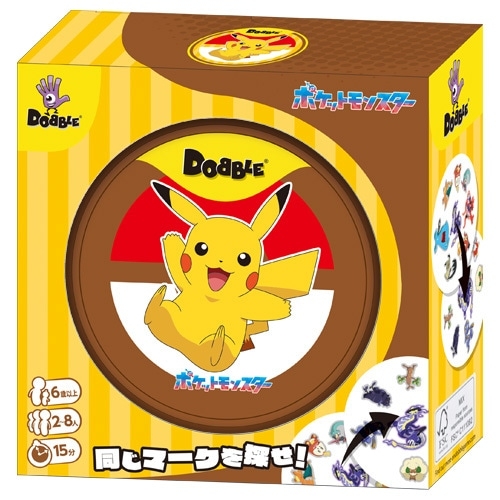
ドブル ポケットモンスター |【公式】ポケモンセンターオンライン
ドブル ポケットモンスターをご紹介。ポケモンセンターオンラインではポケモンセンターオリジナルグッズや最新ゲームソフト、ポケモンカードゲームなど、オフィシャルショップならではの最新情報をお届けします。
www.pokemoncenter-online.comHow to Think About Educational Benefits
When evaluating kids' board games for "educational value," the most honest framing is not a direct tool for academic improvement but rather a way to increase the number of times a child thinks things through during play. Topics like creativity and non-cognitive skills are genuinely appealing, but overstating them isn't useful. Board games can plausibly help with waiting your turn, trying again after a loss, noticing what your opponent is doing and adjusting — but saying "this game will definitely develop that skill" isn't supportable.
Board games aren't a novelty in educational settings anymore. As reported in Japanese education publications like Kyoiku Shinbun and Impress Education ICT, games are being integrated into classroom community-building and project-based learning. What's valued in those contexts isn't the winning or losing — it's games as prompts for dialogue and as experiences of trial and error. What makes games useful in classrooms is that they get students participating in a different register than desk-based learning: they make decisions under rules, in short cycles, in interaction with peers.
Research supports cautious optimism. An exploratory study on J-STAGE found an upward trend in a divergent association task after a three-month intervention — a reasonable basis to suggest potential links to creative thinking. But as exploratory research, it would be unwarranted to generalize that finding across different ages, game types, or conditions. The honest position: "there's an interesting signal here — not a universal conclusion."
What I saw firsthand in classrooms and homes fits that same careful framing. Kids who played Ubongo repeatedly would start moving from trial-and-error to a more structured approach: "break this shape into two pieces and fit them separately." There was a visible shift in how they mentally assembled spatial problems. I'm not claiming that led to better math scores — but changes in how they approached spatial reasoning and experimentation were real. That's a different, more honest claim.
The pattern is similar for non-cognitive skills. Quoridor naturally creates moments of pausing before placing a fence. Nandja Monja and Dobble have a reset rhythm built in — lose a round, start the next one immediately — which makes emotional recovery easy. These repeated moments may plausibly support persistence and social ease, but games don't do that work alone. The adult's presence, tone, and how the playing environment is set up matter enormously. Which is why "could become a prompt for growth" is the more honest framing than "will develop this skill."
ℹ️ Note
At home, "we play because it's fun and then keep playing" tends to work far better than "we play because it's educational." The thinking skills and persistence often show up later, as a byproduct of consistent, enjoyable play — not as something you can deliberately engineer.
Kids don't rally around "let's do it because it's good for us," but they absolutely rally around "I was so close last time — I want another shot." When Ubongo's puzzle challenge, Blokus's placement creativity, or Splendor's anticipation mechanics attach to that motivation, thinking time accumulates naturally. If educational benefit is what you're after, lead with the fun, not the framing — that's what actually gets games played, and played enough to matter.
Pre-Purchase Checklist
The biggest source of buyer's remorse with board games isn't the game itself — it's misjudging whether it'll actually get played at home. Something looks great in a store or in photos, but then: "the pieces are tiny," "cleanup is a hassle," "one game takes forever," "explaining it is harder than expected." Six dimensions make this assessment easier.
Start with Small Parts
The most practical thing is to look past the age number and check what's actually in the box. Dobble (2023 edition) plays entirely with cards — no scattered pieces, which is exactly why it keeps coming back to the table. Gemstone has gem tokens. Game of Life has figurine pegs and car pieces. Catan and similar games have small board pieces and cards throughout. For games like these, the listed age is only part of the picture — the actual size of the components shapes the real-world experience.
Toy safety standards have formal definitions for small parts, but for home use there's no need to get technical. Simply asking "is it mostly cards, or are there multiple small items to pick up with fingertips?" is enough. If you're choosing a first game for ages 4–5, fewer small parts means easier setup and less parental overhead, which means the game actually gets used.
Cleanup Ease Makes a Bigger Difference Than You'd Expect
Easy to overlook before buying, but how easy cleanup is directly affects how often a game gets played. Three things to check: whether the box has dividers, whether pieces can be bagged separately, and whether a little mixing doesn't make things worse.
Nine Tiles, for example, is tile-based with clear roles for each piece — putting it away is intuitive. Blokus has 21 pieces per color (84 total), which is satisfying during play but requires gathering by color when you're done — a small but real step. Game of Life, with its paper money and miscellaneous components, is the kind of game where "do I have the energy to set this up today?" is a real question at the start of the evening. A divided insert or a zip-lock bag can meaningfully raise a game's Replayability, which is a dull point but an important one.
Calibrate Playtime to Weeknight Reality
In home settings, the actual round length matters more than the recommended age. A useful benchmark: 15 minutes or under for weeknight play, up to 30 minutes on a relaxed day. By that measure, Gemstone (~5 minutes) and Nandja Monja, Dobble, and Nine Tiles (~15 minutes each) are reliably accessible options. By contrast, the standard Game of Life run or Catan's 60–120 minutes may be genuinely heavy for a post-dinner "let's play one game" impulse — worth noting, not a dealbreaker.
Does It Handle Losing Gracefully?
For kids, how a loss lands matters more than whether there's a winner or loser at all. Short rounds, immediate rematches, and team or cooperative elements all soften the emotional weight.
Dobble and Gemstone in the 5–15 minute range let kids reset quickly after a loss. In my experience, running three rounds of a 5-minute game as a "best of three" consistently produces more satisfaction than one long single game. The sting of each individual round is lighter, and "I can catch up" is always visible. Long games that end in a blowout can hit hard for the right child on the wrong day — not a reason to avoid them, but worth noting.
💡 Tip
For a child who takes losses hard, splitting a session into multiple short games tends to work well. Lighter stakes per round naturally redirect their focus from "I lost" toward "what do I do next time?"
The Rules explanation Burden Is Real
Games that get played at home tend to have short explanations. A useful bar: can the core concept be conveyed in under three minutes, ideally through a demonstration? "Watch how I do this first round" is a powerful teaching tool.
Getting the rules right matters less than getting the game moving. More on how to make Rules explanation stick — pacing, demo techniques, scripted templates — is covered in the companion article on board game instruction techniques.
Think About Price in Genre Ranges, Not Individually
Price makes more sense as a range by category than as an individual number. Card games typically run ¥2,000–3,500 (~$13–$23 USD); board games with more components fall in the ¥3,000–6,000 (~$20–$40 USD) range. For reference: Engames Shop lists Dobble (2023 edition) at ¥2,200 (~$15 USD) (as of 2026-03-14); Arclight Games lists Gemstone at ¥3,300 (~$22 USD) (as of 2026-03-14); Kakaku.com shows Ubongo around ¥3,432 (~$23 USD) and Splendor around ¥4,973 (~$33 USD) (both as of 2026-03-14). More components generally means higher price.
Game of Life appeared with a reference price around ¥3,480 (~$23 USD) on Kakaku.com — accessible for a board game, and the component volume can feel like good value. But once you factor in play length and cleanup, price alone rarely closes the deal one way or the other. A cheap game that never gets played is still a waste; value comes from how often it's actually used.
The Decision Order When You're Stuck
When I'm helping someone choose, this is the sequence I walk through:
- How many small parts does it have?
- Is cleanup going to be a pain?
- Is it short enough for a weeknight game?
- Can a losing child reset and try again immediately?
- Can the parent explain it in under three minutes?
- Does the price make sense for how often you'll actually play it?
Walking through this list filters out "looks fun but won't survive the week." Especially for that first game, the strategic depth matters less than whether it's easy to pull out and whether it leaves everyone wanting another round. The right "next game" becomes obvious once a family has built the habit of playing together.
Stuck? Start with These Three Types
Rather than mapping every variable, I'd narrow to three archetypes that are almost impossible to miss. Going deep on age and preference eventually gives you a great answer, but in practice the most important question is whether the game actually works the first time it's played. Framed that way, the field simplifies.
First Game: Nandja Monja or Dobble
For the lowest-risk first game, it's Nandja Monja or Dobble. Both are hard to explain badly — the Rules explanation takes one to two minutes tops. Open the box, show one card, say "find the match" or "call out the name when you see it again," and you're already playing.
Nandja Monja is 4+ and starts generating laughs the moment players start naming creatures — the absurd names themselves are the warmup. Dobble is 6+ and rewards whoever shouts the match first, so kids and adults are genuinely competing from turn one. Both make the child feel like a real competitor rather than a participant being managed. These are the two games I'd reach for without hesitation.
Parent-Child Competition: Quoridor
For dedicated parent-child play, Quoridor is the clear answer. The two-player game is immediately compelling — move forward or place a fence, every turn, with real consequences. Each player's 10 fences create natural tension around when to use them: burn through them early and you're exposed at the end, which kids figure out on their own.
It's a thinking game that still ends quickly. A light two-player session doesn't overstay its welcome, and even with three players the pacing works well. I know families where Quoridor became the "one game before bed" ritual that stuck for six months after a birthday gift — not a special occasion game, but a built-into-daily-life game.
Long-Term Step-Up: Catan, Splendor, Blokus
Around ages 8–10, when the appeal shifts from reflex and memory toward strategic thinking, Catan, Splendor, and Blokus are the bridge.
Blokus has a low rules barrier but produces clear skill gaps quickly — a natural first step into strategy games. Splendor rewards sequential planning — tracking what to take, where your opponent is heading — and delivers "I thought ahead and it worked" satisfaction within 30 minutes. Catan is the deepest of the three: negotiation, resource management, and expansion all combine, which means a family session generates a lot of conversation. That conversation is part of the value, but it also means the game needs to land right to create momentum for a second session.
All three games assume children who are ready to have their own strategy, not just children who can follow rules. Adults can play seriously alongside kids, which is what makes these long-term family games rather than "kids' games."
If this comes up in a gift context, the short version: **for maximum first-night success, go with Nandja Monja or Dobble; for parent-child competition, go with Quoridor; for a game that grows with them over years, Catan, Splendor, or *Blokus***.
Next Steps
Locking in the decision is faster once you fix the order of questions. Plenty of families freeze not because they lack information but because they're comparing across too many variables at once. A fixed sequence handles that.
Start by committing to one age range. Even in households with siblings at different ages, it's more efficient to say "today we're looking at 4–5" or "this time we're focused on 8–10" than trying to serve everyone at once. Mix them and the candidate list explodes.
Next, decide on the most common player count. Is it usually a parent-child pair? A family of three or four? Or does it sometimes stretch to five or more when extended family visits? Two-player households will find Quoridor fits well; three-to-four player households will find Blokus and Splendor dependable; if you're sometimes hitting five or more, Dobble (2023 edition) (2–8 players, ~15 minutes) and Nandja Monja and Gemstone (both up to 6 players) handle the range.
Then cut by your household's realistic session length. Under 15 minutes keeps weeknight and pre-bed play available. Up to 30 minutes opens Splendor and similar games. Beyond 45 minutes is fine if you can genuinely set aside the time — but "will it actually get played" is a better criterion than "is it theoretically fun." Gemstone's five-minute sessions and the ~15-minute options (Nandja Monja, Dobble) stay in rotation because they're always accessible.
From there, narrow the shortlist to two or three options. Trying to commit to a single game in one step creates back-and-forth. With two or three candidates on the table, the family conversation becomes concrete: "do we want more laughs or more head-to-head?" "do we want to play it twice fast or settle in?" "does it matter that it ends quickly?" That conversation closes the decision much faster.
At this stage the game comparison is essentially done. For reference: Engames Shop lists Dobble (2023 edition) at ¥2,200 (~$15 USD) (as of 2026-03-14) and Arclight Games lists Gemstone at ¥3,300 (~$22 USD) (as of 2026-03-14) — prices like these are best treated as approximate at time of capture.
ℹ️ Note
Writing out the five items — "age range," "player count," "session length," "two or three candidates," and "safety and price" — on paper tends to make a family discussion resolve in about five minutes. Spoken-only comparisons drift; a written axis holds steady.
What I consistently notice in stores and game spaces is that indecisive families aren't missing information — they're missing a fixed order of questions. Set the sequence and the final choice between Nandja Monja and Dobble, or between Quoridor and Blokus, falls into place naturally. A faster decision means getting home and playing sooner, which is the whole point.
Go Deeper: By Age and By Occasion
More on Choosing for Ages 4–6
As covered throughout, the 4–6 range isn't just about matching the age — round length and immediately intuitive rules make the biggest difference in enjoyment. Nandja Monja is 4+ and starts with naming characters off the card, which generates laughter before the rules are even fully explained. The 60-card / 15-minute design hits its endpoint before children lose focus.
For something even shorter and more tempo-driven, a game that wraps in about 5 minutes — like Gemstone — is the strongest pick. It handles ages 4+ and 2–6 players, with one clear action per turn. "Tired day, but I want to play for a bit" is exactly when this kind of game earns its place. Going the other direction — choosing toddler-aimed games with more component types — tends to add setup and cleanup friction. For a first game, starting with cards only, or with a single clear action per turn, cuts first-purchase risk significantly.
For a more detailed breakdown of ages 4–6 including sibling age gaps, the board game beginner's guide covers the full range and helps identify what's likely to actually stick at home.
Once elementary school starts, the options expand considerably. For grade-by-grade recommendations, the beginner's guide covers the full range.
Elementary school opens up board game options dramatically — but it's worth resisting the urge to treat all those years as one group. In early grades, games like Dobble (2023 edition) and Nine Tiles — short, quick-to-learn, repeatable — stay strong. In middle grades, games with forward-thinking like Quoridor and Blokus start to click. By upper elementary, the planning satisfaction of Splendor or Catan Standard really comes into its own.
The failure mode for elementary-age picks is choosing based on "it seems educational" or "it's famous." What actually matters to the child is a sense of agency — thinking for themselves and having it affect the outcome. Quoridor's fence placement is entirely their decision; Blokus's piece choice changes the whole board. That visible agency is what creates repeat plays.
For grade-by-grade picks from early elementary through upper grades, the dedicated article with 12 recommendations by grade level is the right next step. Use this article for the mental framework; use that one to lock in specific titles.
On Educational Effects and Real Examples
When choosing a board game for educational reasons, what I find most useful is not looking at the skill label — it's watching what actions increase during play. Dobble builds fast-focus search. Quoridor builds reading-ahead judgment before committing to a fence placement. Splendor builds the habit of considering whether to act now or hold. The felt experience of growth is different for each game.
Research-wise, the typical intervention runs three months — which tells you something important: educational benefit isn't something you measure after one session. What families can observe at home is behavioral: "she waits her turn better now," "he narrates his own next move," "they say 'again' instead of storming off." That's where board games deliver something different from desk-based study — the development shows up in the conversation.
Rather than searching under the vague umbrella of "educational games," understanding which games tend to develop which capabilities — and seeing real-world examples — is more useful. The dedicated article on educational effects goes deeper on exactly this, and is particularly relevant for families trying to align what a parent hopes for with what a child actually enjoys.
Family Board Game Roundup
For family play, the question that matters more than "is this a kids' game?" is whether it actually works for your group size. Parent-child pairs do best with something that rewards reading each other — Quoridor style. Groups of three to four need something where everyone's in it — Blokus or Splendor. For more people and more energy, the quick-reaction format of Nandja Monja or Dobble (2023 edition) handles the chaos well.
If a classic, event-driven game sounds right — the kind where the family conversation builds naturally — Game of Life is hard to ignore. Takaratomy's product page notes approximately 30 minutes for the Junior stage and roughly one hour for the standard stage; Kakaku.com has shown a reference price around ¥3,480 (~$23 USD) at times. The appeal is less about rule precision and more about "this is the game we want to gather around tonight."
For a broader look at classic family games that scale from parent-child to grandparents in the room, the family board game roundup article is the place to continue. With family games, there are so many good options that "who is this evening actually for?" is the most useful filter.
When One Player Prefers to Go Solo
It's easy to overlook while reading a family-focused article, but some kids genuinely prefer playing alone. Children who'd rather think at their own pace than navigate the social dynamics of competition often connect strongly with solo-friendly or puzzle-focused games. Among the games covered here, Ubongo's spatial reasoning challenge is a strong candidate: it's about the satisfaction of solving the puzzle, not the energy of group competition.
For these kids, putting them in a noisy group competition and expecting engagement often backfires. At game spaces, I've seen children who won't join group play light up completely when handed a puzzle or solo game — the change in expression is immediate. Playing together vs. playing alone isn't a better/worse question, just a different-preference question.
If focused solo play is the priority, the solo board game recommendations article rounds out the options. Sometimes a family searching for "the right group game" discovers that what their child actually needs most is their own game.
A former nursery school teacher and current board game cafe staff member. With experience recommending games to over 200 groups per month, she finds the perfect match based on player count, time, and group dynamics.
Related Articles
12 Best 2-Player Cooperative Board Games in Japan | How to Choose Without Winners or Losers
Looking for a 2-player board game but worried competitive play will create tension? Cooperative games where you work toward the same goal through conversation are perfect. This article breaks down three types—fully cooperative, high-score update, and one-time experience games—and covers titles like Codenames: Duet, EXIT: The Game, and more.
10 Board Games for Three Generations in Japan | Selection Guide and Comparison
During holiday visits or weekend family gatherings in Japan, kids might enjoy a game while grandparents find it hard to join, or the opposite—adult-focused games bore the children. Picking the right three-generation board game is surprisingly tricky. This guide compares 10 titles based on player count, playtime, and age suitability, from games that flow smoothly even at 6-player tables to 30-minute classics.
12 Best Board Games for Elementary School Kids | By Grade Level
Choosing board games for elementary schoolers gets tricky when everything is lumped together as "for kids." The truth is, younger kids need games with quick rules and short playtimes, while older kids want depth and strategic challenge — and satisfaction levels vary a lot depending on which you pick.
Top 10 New Year's Board Games for Family Fun in Japan | How to Choose Games That Get Everyone Excited
For New Year's family game nights in Japan, what matters most isn't whether a game is a classic—it's whether everyone can jump in immediately and the atmosphere stays positive even when someone loses. When grandparents, parents, and children gather at the same table, celebrated titles like Catan (a trading and resource management game) are reliable, but they can sometimes feel a bit heavy for a first pick.